
— LVNV Funding, LLC:
What New Yorkers Should Know About Letters, Lawsuits and Credit Reports
⚡QUICK ANSWER
LVNV Funding, LLC is a debt buyer that purchases charged-off consumer accounts, often credit cards, and outsources account management to Resurgent Capital Services. harrerlaw If LVNV sued you in New York, you generally have 20 or 30 days to answer. LVNV must prove it owns your account, and debts older than three years are generally time-barred.
Contacted or Sued by LVNV Funding?
Do not ignore a summons or a collection letter. Tariq Law PC reviews LVNV letters, lawsuits and credit reports for New York consumers at no cost, and can tell you what your options are before a deadline passes.
Who Is LVNV Funding?
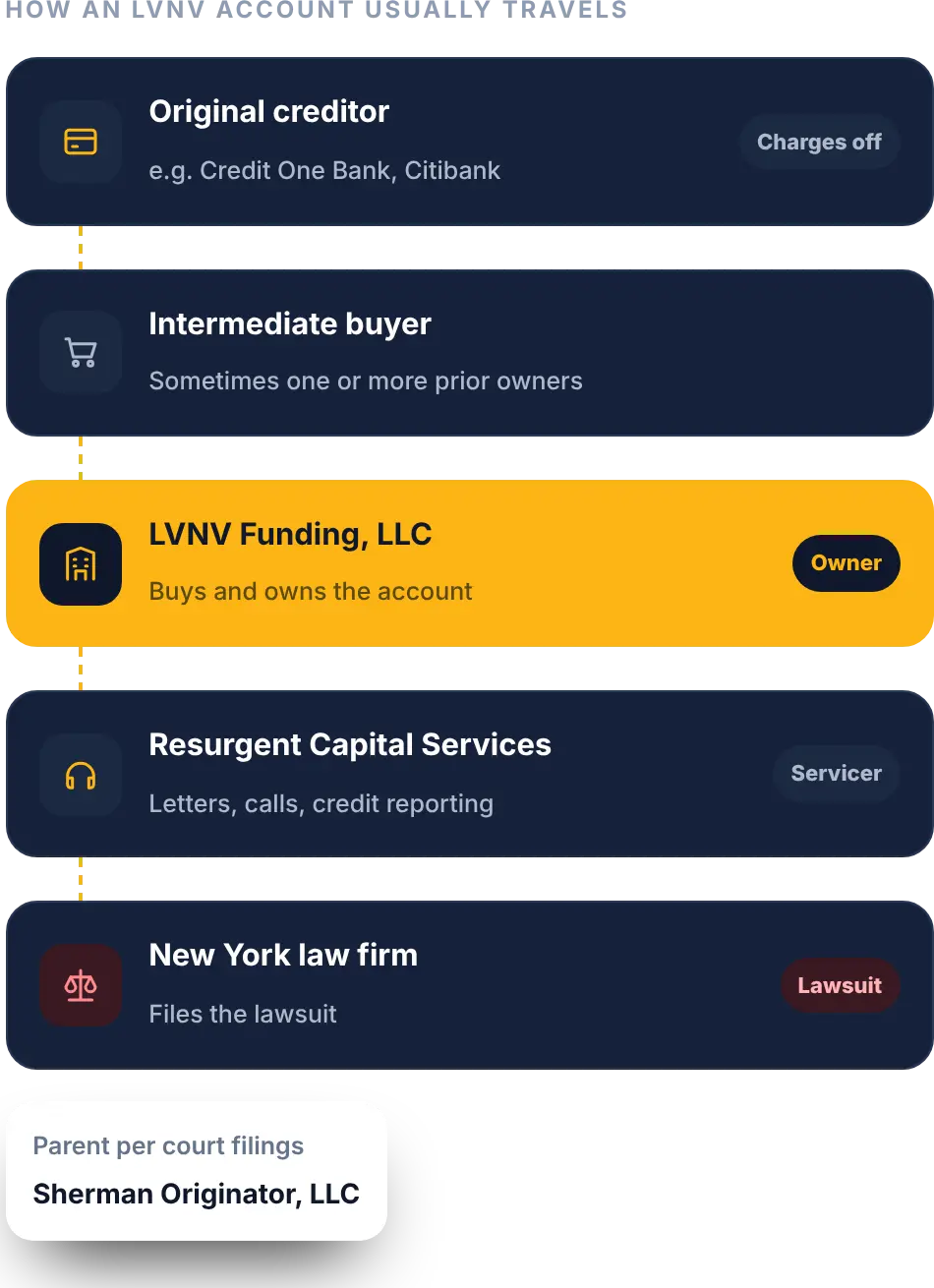
LVNV Funding, LLC is a Delaware limited liability company organized in 2005 that buys defaulted consumer debt. LVNV's own website says it outsources the management of its accounts to Resurgent Capital Services, L.P., and asks consumers to direct inquiries there. That is why your credit report may say "LVNV Funding" while your letters and calls come from Resurgent or a law firm.
| Name | What it is | Where you may see it |
|---|---|---|
| LVNV Funding, LLC | Debt buyer that owns purchased accounts | Credit reports, lawsuit captions ("LVNV Funding LLC a/p/o ..."), court judgments |
| Resurgent Capital Services, L.P. | Servicer that manages LVNV accounts (Greenville, SC; NMLS ID 2301) | Collection letters, phone calls, texts, online payment portal, credit reporting |
| Sherman Originator, LLC | Corporate parent named in LVNV's 2025-2026 federal court disclosure statements | Federal court filings; a 2012 Maryland settlement agreement states the companies "are part of a family of companies under Sherman Financial Group LLC" |

LVNV and Resurgent contact facts

Resurgent customer care
1-888-665-0374

Resurgent mailing address
P.O. Box 10497, Greenville, SC 29603

Resurgent compliance office
Compliance Department, MS 250, P.O. Box 10497, Greenville, SC 29603

NYC language-access line listed by Resurgent
1-866-312-1354

LVNV's address as listed in New York court papers and its NYC license record
355 S. Main Street, Greenville, SC 29601 [VERIFY]

Official websites

NYC Department of Consumer and Worker Protection license
LVNV 1326179-DCA [VERIFY current status]; Resurgent 1204239-DCA
Scam caution: Fake collectors sometimes use real company names. Do not pay through a link in an unexpected text or email. Look up the phone number yourself at https://www.resurgent.com, ask for a written notice, and never give a full Social Security number or bank login to an unverified caller. Resurgent publishes its own scam warning on its website.
Why Does LVNV Have My Account?
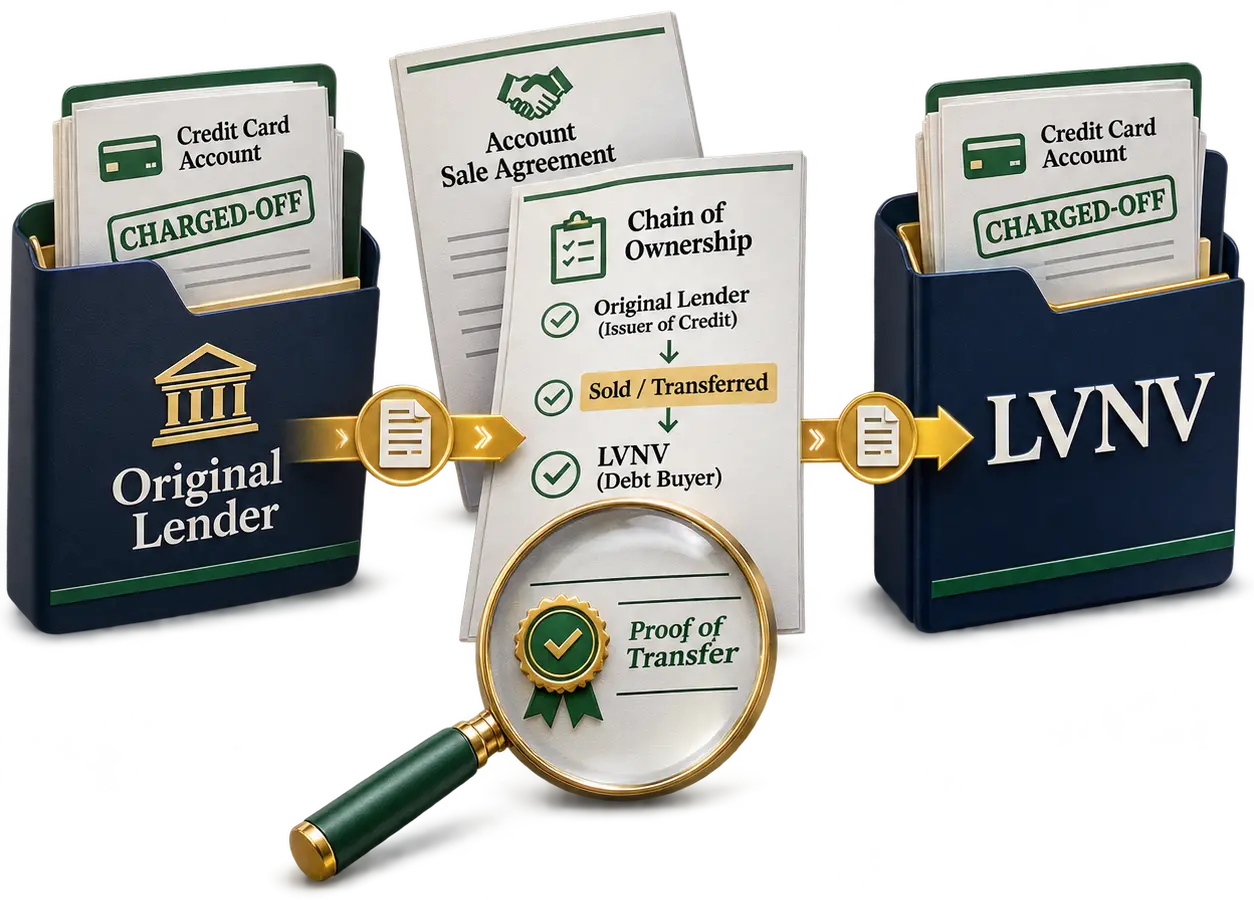
LVNV does not lend money. It buys accounts after the original lender charges them off, sometimes after the account has passed through other buyers. In LVNV Funding, LLC v Washington (2025), for example, a New York court described a Citibank debt that was transferred "through two intermediate owners" to LVNV. Each transfer should be documented, and in New York LVNV must describe that chain of ownership in its complaint.
Credit One and Other Original Creditors
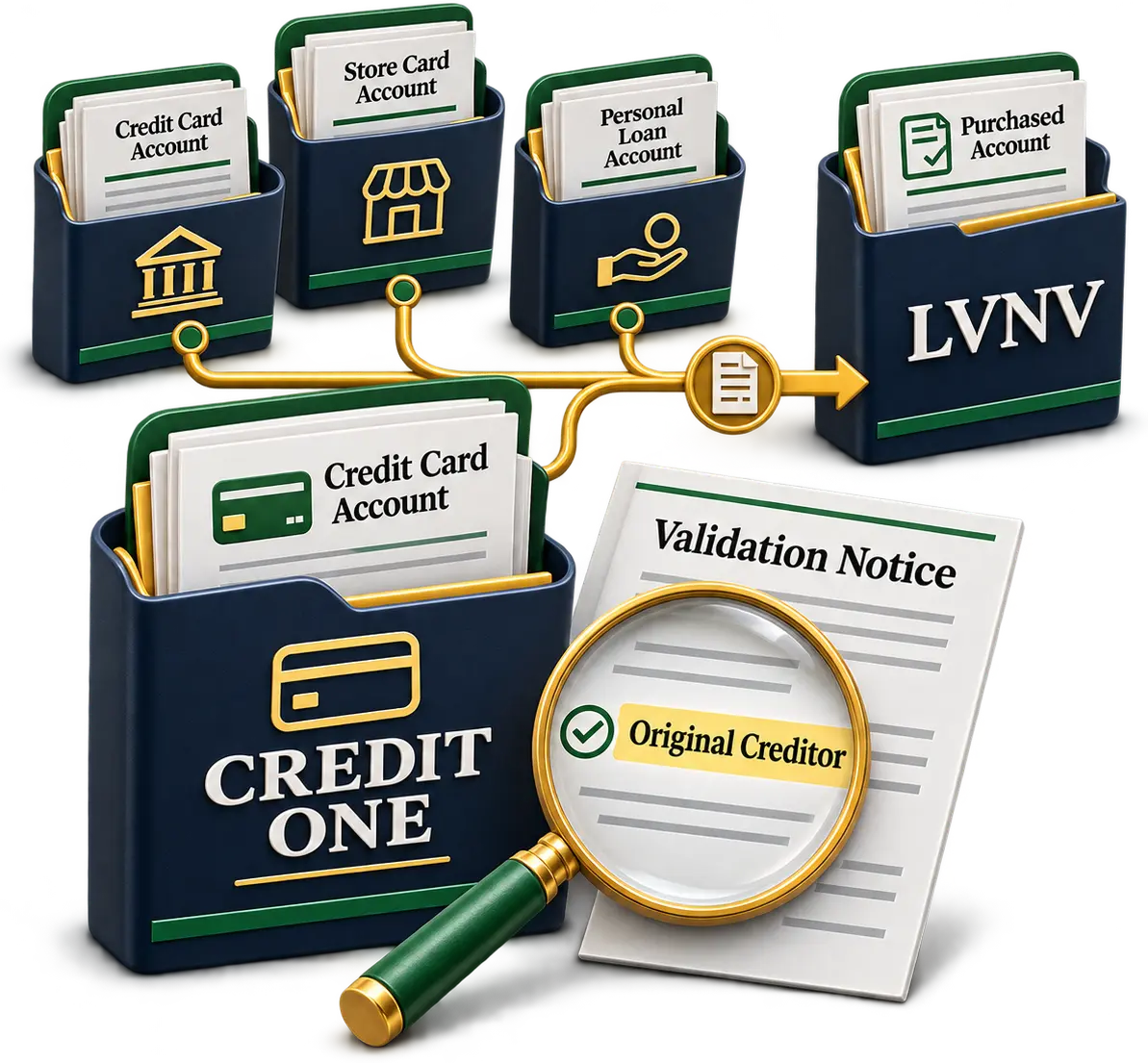
Many LVNV accounts started as credit cards. Credit One Bank is one of the most common original creditors named in LVNV lawsuits and credit reports. LVNV accounts have also originated with Citibank, Capital One, Sears and other store cards, and personal loan lenders. The original creditor's name should appear on your credit report, on your validation notice, and in any New York complaint.
What LVNV Papers and Letters Look Like
➤ Lawsuit caption
"LVNV Funding LLC a/p/o Credit One Bank, N.A." "A/P/O" usually means "as purchaser of." It names the original creditor or prior owner.
➤ Validation notice
a letter from Resurgent (or a law firm) listing the original creditor, account number ending, itemization date, balance, and your 30-day dispute window.
➤ Law firm letter
in New York, LVNV lawsuits are often filed by firms such as Forster & Garbus LLP, Pressler, Felt & Warshaw, LLP and Kirschenbaum & Phillips, P.C.
➤ Summons and complaint
filed in NYC Civil Court, a District Court, a City Court, or Supreme Court, marked "Consumer Credit Transaction."
➤ Required disclosure
papers from a licensed collector in NYC typically state the DCWP license number.



Is LVNV Funding Legit?
Yes. LVNV is a real, licensed debt buyer, and its letters and lawsuits are real. But a real company can still have the wrong balance, the wrong person, or missing ownership documents. Courts have dismissed LVNV cases on procedural grounds. In LVNV Funding LLC v Anova (2025), a Staten Island court dismissed a case as abandoned because LVNV waited too long to seek a default judgment. Treat every LVNV contact seriously, and verify it before you pay.

Why Is LVNV Contacting Me?
● LVNV bought a charged-off account it believes is yours.
● Resurgent or a law firm is sending a validation notice or settlement offer.
● LVNV is preparing to sue, or has already filed suit.
● LVNV already has a judgment and is trying to collect it through a bank restraint or income execution.
● The account may belong to someone else, may be a result of identity theft, or may already be paid or discharged in bankruptcy.
LVNV Letter Checklis
When you get a letter, check:
➤ The name of the original creditor and the last four digits of the account
➤ The itemization date and the balance on that date
➤ Interest, fees and payments added or subtracted since then
➤ Your dispute deadline (usually 30 days after you receive the notice, plus mailing time)
➤ Whether the debt is older than three years from your last payment or default
➤ Whether the letter says LVNV can sue you or report the debt
➤ The sender's contact information, matched against official sources

Caution: Send disputes in writing and keep copies. In New York, a payment on a debt after the three-year limitations period does not restart the clock under the Consumer Credit Fairness Act. Even so, do not make a payment or promise until you understand your rights, especially if you have been sued.
Sued by LVNV Funding in New York: What to Do

Note the date you were served
You generally have 20 days to answer if the papers were handed to you personally and 30 days if service was made another way.
Look up the case
Check the complaint
for the original creditor, chain of ownership, charge-off balance, and attached agreement and charge-off statement.
Check the dates
If the last payment or default was more than three years before the filing date, the claim may be time-barred.
Check the dates
If the last payment or default was more than three years before the filing date, the claim may be time-barred.
File an answer
with the court clerk before the deadline and raise every defense that applies, including the statute of limitations and lack of standing.
Keep your address current
with the court and watch your mail for motion and trial dates.
Talk to a consumer lawyer
before you negotiate. An LVNV lawsuit may also reveal FDCPA violations that offset or exceed the claimed balance.

What LVNV Must Prove (CCFA Checklist)
Under New York's Consumer Credit Fairness Act and CPLR 3016(j), a debt buyer's complaint must include specific details. Check whether LVNV's complaint includes:
● The name of the original creditor
● The last four digits of the original account number
● The date and amount of the last payment
● The charge-off date and charge-off balance
● An itemization of interest, fees and payments since charge-off
● The names of every prior owner and the date of each transfer
● The account agreement or other writing that governs the account
● The charge-off statement or another document showing the debt
● A statement that the claim is within the statute of limitations
At trial or on a default motion, LVNV must also show admissible proof that it owns your account and that the amount is correct.
Common Defenses in LVNV Cases
Under New York's Consumer Credit Fairness Act and CPLR 3016(j), a debt buyer's complaint must include specific details. Check whether LVNV's complaint includes:
● Statute of limitations: three years for most consumer credit claims in New York (CPLR 214-i)
● Lack of standing: missing or incomplete chain of ownership from the original creditor to LVNV
● Defective complaint: missing CPLR 3016(j) information or required attachments
● Improper service: you were never properly served
● Wrong person or identity theft: the account is not yours
● Paid, settled or discharged: the debt was resolved or discharged in bankruptcy
● Incorrect amount: unsupported interest, fees or balance
● Abandonment: LVNV failed to seek a default judgment within one year (CPLR 3215(c))

Prior results do not guarantee a similar outcome. Not every defense applies to every case.
Already Have a Default Judgment?

Look up the judgment on WebCivil Local and get the case file.

Act quickly. Delay can make it harder to vacate the judgment.
If you were not properly served, or you have a reasonable excuse and a valid defense, you may be able to move to vacate the judgment (for example, under CPLR 5015 or CPLR 317).

Social Security, SSI, veterans benefits and certain other benefits are generally exempt.

A judgment can lead to a frozen bank account or a wage garnishment. Effective January 1, 2026, New York protects $4,080 in bank accounts for people employed in New York City, Nassau, Suffolk and Westchester, and $3,840 for people employed elsewhere in the state. Directly deposited exempt benefits are protected up to $3,425 under CPLR 5205(l) and 5222(h), an amount in effect since April 1, 2024 and next adjusted April 1, 2027.
Learn more: default judgments, frozen bank accounts, garnished wages
LVNV Funding on Your Credit Report

Who reports it
Resurgent generally furnishes LVNV account information to Equifax, Experian and TransUnion.Resurgent generally furnishes LVNV account information to Equifax, Experian and TransUnion.

How long it can stay
An accurate collection account can generally remain for seven years plus 180 days from the original delinquency, not from the date LVNV bought it.

Common errors
Wrong date of first delinquency (re-aging), duplicate entries for the original creditor and LVNV, wrong balance, accounts that are not yours, and disputes not marked as disputed.
How to dispute
Dispute with each credit bureau reporting the account and in writing with Resurgent. Keep copies and proof of mailing.

Pay for delete
We are not aware of any published pay-for-delete policy from LVNV or Resurgent, and no law requires a collector to agree. Paying usually updates the account to "paid" or "settled" rather than removing it. If you negotiate any reporting terms, get them in writing before you pay.
If an inaccurate LVNV account stays on your report after a dispute, you may have a Fair Credit Reporting Act claim. Learn more:
credit reporting error and identity theft fraud
Will LVNV Settle?
➤ LVNV and Resurgent regularly offer settlements and payment plans, including after a lawsuit is filed.
➤ Before paying, confirm that the debt is yours, that it is not time-barred, and that the amount is correct.
➤ Get every settlement in writing. The writing should state the amount, the due dates, that the payment resolves the account in full, and how the account will be reported.
➤ If you have been sued, the settlement should include a dismissal or a satisfaction of judgment filed with the court.
➤ If $600 or more of debt is canceled, you may receive an IRS Form 1099-C. Canceled debt can be taxable unless an exception, such as insolvency, applies. Ask a tax professional.
➤ Keep proof of every payment.


Regulator Actions and Lawsuits Involving LVNV
These are matters of public record. Settlements are not findings of wrongdoing unless stated.
Maryland (2012)
$1m
penalty
In a June 2012 settlement agreement with the Maryland State Collection Agency Licensing Board, LVNV and Resurgent agreed to pay a $1,000,000 penalty and to dismiss 3,564 pending cases without prejudice. The agreement states that the companies "expressly deny any such liability or wrongdoing."
New York Attorney General (May 8, 2014)
$175,000
civil penalties and costs
Sherman Financial Group agreed to pay $175,000 in civil penalties and costs. It also agreed to seek to vacate more than 400 judgments that the Attorney General's release called "improper judgments" on claims the office said were time-barred, and to stop collecting on them. The release does not address admission. A Mondaq summary from May 15, 2014 reports that "neither company admitted any of the allegations." [VERIFY against settlement text]
Connecticut Department of Banking (Aug. 26, 2021)
$2,500
civil penalty
A consent order resolved the Banking Commissioner's allegation that Resurgent collected interest on certain Connecticut consumer accounts in violation of state regulations. Resurgent paid a $2,500 civil penalty and neither admitted nor denied the allegations.
Class actions
$80,000
class recovery
In re LVNV Funding, LLC FDCPA Litigation (D.N.J.) received final approval on July 9, 2020, covering more than 378,000 New Jersey class members. Tabiti v. LVNV Funding (N.D. Ill.) settled for a total class recovery of $80,000.
Key court decisions
Crawford v. LVNV Funding (11th Cir. 2014), later limited by Midland Funding v. Johnson (U.S. 2017); McMahon v. LVNV Funding (7th Cir. 2014), on collection letters for time-barred debts; LVNV Funding v. Finch (Md. 2019); Thomas v. LVNV Funding (7th Cir. 2025), reversing a small FCRA verdict for lack of standing.
New York (2025)
LVNV Funding, LLC v Washington (App Term 2d Dept) held that a debt transfer during the consumer's bankruptcy did not violate the automatic stay. LVNV Funding, LLC v Barrow (App Term 2d Dept) addressed LVNV's standing as a debt buyer. [VERIFY]
Federal regulators
We found no CFPB or FTC enforcement action against LVNV Funding or Resurgent as of November 2026. You can search consumer complaints at www.consumerfinance.gov
Can I Sue LVNV Funding?
You may have a claim if LVNV, Resurgent, or a law firm collecting for them broke the law:
➤ FDCPA: false or misleading statements, suing on time-barred debts, collecting amounts not owed, or contacting you after you told them in writing to stop. Remedies can include actual damages, statutory damages up to $1,000, and attorney's fees. Review: https://tariqlaw.com/fdcpa-violations-checklist
➤ FCRA: failing to reasonably investigate a dispute, or reporting inaccurate information. Remedies can include actual damages, statutory damages for willful violations, and attorney's fees.
➤ Regulation F: a collector is presumed to violate the call-frequency rule if it calls more than seven times within seven days about a debt, or within seven days after a phone conversation about it.
➤ TCPA: Robocalls or texts to your cell phone without consent.

Talk to a New York Consumer Protection Attorney
If LVNV sued you, froze your account, or is reporting something you believe is wrong, call (866) 885-8529 or email [email protected].
Why work with Tariq Law PC?
Focused practice
We defend New Yorkers in debt collection lawsuits and bring claims under the FDCPA and FCRA.
Attorney involvement
Subhan Tariq, Esq. was admitted to the New York bar in 2014 and is a member of the National Association of Consumer Advocates (NACA). Learn more on his attorney profile and read client reviews.
Clear fees
We explain how fees work, in writing, before you hire us.
Local
Our office is at 99 Park Avenue, Suite 1530, New York, NY 10016. We serve all five boroughs, Long Island, Westchester and clients throughout New York State.

Federal Consumer Rights Attorney
Specializes in federal consumer protection laws like FCRA, FDCPA, and EFTA. Represented thousands of consumers facing identity theft, mixed credit files, and post-bankruptcy reporting errors.

Communication
Always on your side.

Integrity
Honesty at our core.

Excellence
Pursuing the highest standards.
Tariq Law PC Reviews: What Our Clients Say
Our clients share their experiences working with a legal team dedicated to protecting their rights and pursuing the best possible outcome.
I was really at a point of giving up on my case and accepting my loss on this lawsuit. As a last resort I reached out to a few law firms and everyone refused to help me until I spoke with Tariq Law Firm. Subhan, Carlos, and Shahbaz were honest, set realistic expectations and then proceeded to exceed them! My case already went through the court and received a judgement against me that would require me to pay the debt collector more than what I was being sued for plus their court fees. To my amazement, Tariq's firm was able to turn that judgement around completely and force the Plaintiff to settle for less than a 1/4 of what the judgement required. I cannot highlight enough how great of an experience this was! I will recommend their firm to everyone I can who needs legal aid in the services they offer. I won't need this service in the future but if I ever find myself in a space where I do, this firm will be my FIRST call. I am so grateful for this team and their customer service. They are worth every penny! 10/10


I reached out to Tariq Law regarding a potential FDCPA claim. The firm replied quickly, examined my documents before our call, and arranged a consultation. Mr. Tariq offered a straightforward evaluation of my situation and clarified which violations might support a claim and which would not. He avoided exaggerating my case. Although I did not retain the firm, I prefer an honest response to a sales pitch. I suggest a consultation for anyone facing a debt collection issue.

I met with Mr Tariq about time barred debt lawsuit I was fighting Pro Se. When other offices wanted $400 just for the consult, Tariq Law did the consult for free and gave me some solid advice on how to settle. I’m still waiting on the outcome of my case but being able to get the advice of a lawyer in a day for free gave me the insight and confidence I needed to wrap my case up. Also, they respond FAST.

I highly recommend Tariq Law, PC! Subhan and Carlos were both incredibly professional, knowledgeable, and helpful throughout the entire process. They took the time to listen to my concerns, explain everything clearly, and made sure I understood what was happening every step of the way. Their communication and attention to detail really stood out, and I felt like my situations was genuinely being taken seriously. I’m very grateful for their assistance and would absolutely recommend Tariq Law, PC to anyone dealing with credit report issues, debt collection, or related financial matters. Excellent experience!

Amazing firm , very professional, respond to all questions and always available on the phone , email or text . Tariq and his assistant were really great during a very stressful time . Thank you again

I can't express how grateful I am to have Tariq Law as my consumer debt attorney. From the very first consultation, it was clear that I was in expert hands. His extensive knowledge of consumer debt laws and processes helped me understand my options better than I ever could have on my own. He took the time to explain everything thoroughly and patiently answered all my questions, which really eased my anxiety during a very stressful time. What really impressed me was his exceptional customer service. Tariq Law was always available when I needed guidance, and his commitment to my case was evident. He truly cares about his clients and goes above and beyond to ensure they feel supported. The scheduling process was also seamless. Appointments were flexible, accommodating my busy life, which made everything so much easier. If you're struggling with consumer debt, I highly recommend Tariq. He not only knows his field inside and out but also treats you with respect and kindness. Thank you for all your help! Not my first time using him and it won't be the last!!!

I highly recommend Tariq Law for anyone needing professional and reliable legal guidance. From the start, Subhan was incredibly helpful and knowledgeable, providing me with a clear and strategic plan to navigate my situation with confidence. The communication from the firm is outstanding. The intake manager was amazing—proactive, highly responsive, and kept me informed through every step of the process. In a situation where you need quick answers and genuine expertise, they delivered every time. I have nothing but positive things to say; they are a top-tier team that truly prioritizes their clients success.

I recently had a consultation with Attorney Subha Tariq regarding a complicated medical-debt dispute involving insurance, Medicaid, provider billing, and collection activity. I presented the five main documentary defenses I had gathered, and he took the time to review and discuss each one carefully. What impressed me most was how clearly he explained the important details. He helped me understand how the documents could support my position, what issues required more attention, and how the evidence should be organized if the dispute continues. He was patient, compassionate, and respectful throughout the conversation. I never felt rushed or dismissed, even though my case involves many documents and complicated facts. Attorney Tariq was also honest and practical. He did not make unrealistic promises, but he gave me a clearer understanding of my situation and the possible path toward resolving the debt issue. After speaking with him, I felt more informed, more organized, and more confident about protecting my family. I strongly recommend Attorney Subha Tariq to anyone facing a disputed debt or collection matter. He listens carefully, explains legal issues in a way that is easy to understand, and treats clients with genuine compassion and professionalism

I met with Subhan Tariq and was very impressed with his professionalism, responsiveness, and depth of knowledge. He took the time and answered my questions thoroughly, and provided clear, practical guidance without any pressure. I left the conversation feeling much better informed and with a clearer understanding of my options moving forward. I would highly recommend Subhan and his firm to anyone looking for thoughtful and knowledgeable legal counsel.

I can't thank this law firm enough for everything they did for me. The entire team was professional, knowledgeable, and supportive from beginning to end. They kept me informed throughout the process, answered all of my questions, and made me feel confident every step of the way. Thanks to their hard work and dedication, both of my cases were dismissed. I truly appreciate everything the team did for me and couldn't be happier with the outcome. I highly recommend this law firm to anyone looking for a team that genuinely cares about their clients and works hard to achieve the best possible results.

I have had a phenomenal experience working with Tariq Law, starting with their Intake team. After sending across all information pertaining to my case, I received a response back quickly and had a very helpful 50-minute consultation with Subhan Tariq and the full team. The team has been incredibly responsive over email and text, very helpful in refining and putting together all documents being sent out, very receptive to all question I have had throughout the process, incredibly organized, and very enjoyable to work with overall. I'm very grateful to have found an incredible legal team and would highly recommend.

I met with Mr Tariq about time barred debt lawsuit I was fighting Pro Se. When other offices wanted $400 just for the consult, Tariq Law did the consult for free and gave me some solid advice on how to settle. I’m still waiting on the outcome of my case but being able to get the advice of a lawyer in a day for free gave me the insight and confidence I needed to wrap my case up. Also, they respond FAST.

I want to thank Tariq Law PC for helping me resolve a legal matter I was dealing with. From the start, the team was professional, responsive, and made sure I understood every step of the process. Thanks to their guidance, my case was resolved successfully, and I couldn't be happier with the outcome. I highly recommend Tariq Law PC to anyone in need of legal assistance.

Tariq Law P.C. is professional, honest , and highly knowledgeable. They laid out their understanding of my case and advised me on the best strategies that would benefit the outcome of my cases. The staff worked diligently for over a year on my cases that yielded results beyond my expectations. Everyone who worked on my case from Subhan to Huzifah to Carlos were all profoundly professional, kept me abreast of the process, asked for my insight on matters and informed me on all aspects of my defense. I appreciate their support, hard work, and commitment to their clients and I’m glad I made the decision to be one of their clients. All the best.

Overall, my experience with Attorney Subhan and his intake team has been excellent. From the beginning until now, they have been very responsive and consistent in their communication through calls, texts, and emails. They always follow through on what they say and make sure to keep me updated on my case. I haven't had any issues so far, and I truly appreciate the level of support and professionalism. I would rate their service a 10 out of 10 and would definitely recommend them to my friends and family."

I’m very grateful to Tariq Law PC for their professional and dedicated assistance with my credit report issue. They were knowledgeable, responsive, and kept me informed throughout the process. Most importantly, my credit reports were successfully corrected. I truly appreciate their hard work and highly recommend Tariq Law PC! Highly professional and efficient. They helped us navigate numerous challenges successfully. I'm very satisfied with their services. We are so grateful for your firm's support. You've helped us solve so many problems with great efficiency. Thank you for your excellent work

I had a very positive experience working with Subhan Tariq and the team at Tariq Law. They were exceptionally efficient, prompt, and helpful throughout the process. Communication was straightforward, and they provided clear, direct answers right away. I highly recommend their legal services to anyone looking for professional and responsive counsel.

I am incredibly grateful for the outstanding service I received from Tariq Law. Having consulted with him three times now, I can confidently say that his wealth of knowledge in consumer debt law is truly impressive. What really sets him apart is his patience and willingness to listen to my concerns. He took the time to explain my options clearly, ensuring I understood each step of the process. His customer service is unmatched; I always felt valued and supported during our consultations. Additionally, scheduling appointments with him is a breeze. It's convenient and really helped me manage my time effectively, which made the entire experience much less stressful. If you're looking for a knowledgeable and approachable consumer debt attorney, I highly recommend Tariq Law! iDIGGit Promising Poodles, Owner

The entire team was so helpful, from getting an appointment to actually speaking with the lawyer. The intake team was really quick to respond and helped with any and all questions I had. Subhan was amazing too, and really broke everything down in an easy to understand way. Would 100% recommend to anyone needing their services.

I had an excellent experience with Tariq Law, P.C. The entire staff, including Carlos, handled my case with extreme efficiency. They resolved my legal matter immediately, and I was thrilled to achieve a resolution without having to pay the creditor back. I highly recommend their services to anyone in need of expert legal representation.

Great Law office. Gave me a free consultation concerning my identity theft/fruad case. Sarah the intake manger and Subhan Tariq were extremly helpful and effectively communicated to me what to do in my situtation. I highly recommend this law firm.

Highly recommend this law firm. I was a victim of aggressive and shady debt collectors and Tariq Law helped me stop their harassment and to solve my case. Shout out to Subhan, Carlos, and the rest of the team. Don’t even look elsewhere, this is the place. Thank you guys!

scheduled a consultation with this firm not realizing they only represent clients in New York, while I’m located in Los Angeles. Despite that, the attorney provided me with a generous amount of guidance, shared referrals in my area, and even refunded my consultation fee. You don’t find service like this anymore. The intake team was also incredibly responsive and processed my refund right away. I highly recommend this firm.

Tariq law team is very kind, helpful, and cooperative. Also, the attorney is very professional ,informative and knowledgable and can provide an outstanding solution to any legal problem in his field of expertise in a very professional manner

AS SEEN ON!













Ready to Talk About Your Case?
Whether you’ve been sued for a debt, found an error on your credit report, or had a bank deny your fraud claim, we can review your situation and explain your options.
Email: [email protected]
Phone: (866) 885-8529

Quick FAQs
Find clear, honest answers to common question from a experience professional.
Is LVNV Funding a legitimate company?
Yes. LVNV Funding, LLC is a real Delaware debt buyer that purchases charged-off consumer accounts and outsources account management to Resurgent Capital Services. Being a real company does not mean every balance is correct. You can ask for validation, check the chain of ownership, and dispute errors before paying anything.
Why is LVNV Funding on my credit report?
LVNV usually appears after an original creditor, such as a credit card issuer, charged off an account and the debt was sold, sometimes through other buyers, to LVNV. Resurgent Capital Services generally handles the reporting. Check the original creditor, balance, and date of first delinquency, and dispute anything you do not recognize.
How long do I have to answer an LVNV lawsuit in New York?
In New York consumer credit cases, you generally have 20 days to answer if the papers were handed to you personally and 30 days if service was made another way. Check the summons, look up the case on WebCivil Local, and contact a lawyer quickly, because missing the deadline can lead to a default judgment.
Can LVNV Funding sue me for an old debt in New York?
Under the Consumer Credit Fairness Act, most consumer credit lawsuits in New York must be filed within three years, and a payment after that period does not restart the clock. If the debt is older, the statute of limitations may be a complete defense, but you usually must raise it in your answer.
Will LVNV Funding agree to pay for delete?
We are not aware of a published pay-for-delete policy from LVNV or Resurgent, and nothing requires them to agree. Accurate collection accounts can generally remain for seven years plus 180 days from the original delinquency. If you settle, get the terms in writing before paying, including how the account will be reported, and keep proof of every payment.
What does "a/p/o" mean on an LVNV lawsuit?
"A/P/O" usually stands for "as purchaser of" and is followed by the name of the original creditor or a prior owner, for example LVNV Funding LLC a/p/o Credit One Bank. It tells you who LVNV claims it bought the account from, which LVNV must support with chain of ownership documents.
What if LVNV already has a default judgment against me?
You may be able to ask the court to vacate it, especially if you were never properly served or have a valid defense. Act quickly, because a judgment can lead to frozen bank accounts or wage garnishment. In New York, some exempt funds, including certain benefits, are protected from restraint.
Can I sue LVNV Funding or Resurgent?
Possibly. If a collector made false statements, sued on a time-barred debt, reported inaccurate information after a dispute, or called you too often, you may have claims under the FDCPA or FCRA. These laws allow statutory damages and attorney's fees in qualifying cases. A consultation with Tariq Law PC is free.
Tariq Law, PC. is located in the heart of New York City at 99 Park Avenue, footsteps from the iconic Grand Central Terminal in Midtown Manhattan. We serve clients primarily in New York, New Jersey, and in federal courts across the United States.
In order to evaluate your particular circumstances, please reach out to us to schedule an individual case review. Using this site or communicating with an attorney does not establish an attorney-client relationship, which can only be established in writing and signed by the lawyer and the client.
Prior results do not guarantee a similar outcome. This website is for informational purposes only.
Attorney Advertising.
NYC's premier consumer protection law firm. We fight for justice in FCRA, FDCPA, identity theft, and debt defense cases with unmatched expertise and tenacity.
Email: [email protected]
Phone: (866) 885-8529
Location: 99 Park Avenue New York, NY 10016


subscribe Our Newletter
Copyright 2026. TariqlawPC. All rights reserved. Read more from Subhan at subhantariq.com