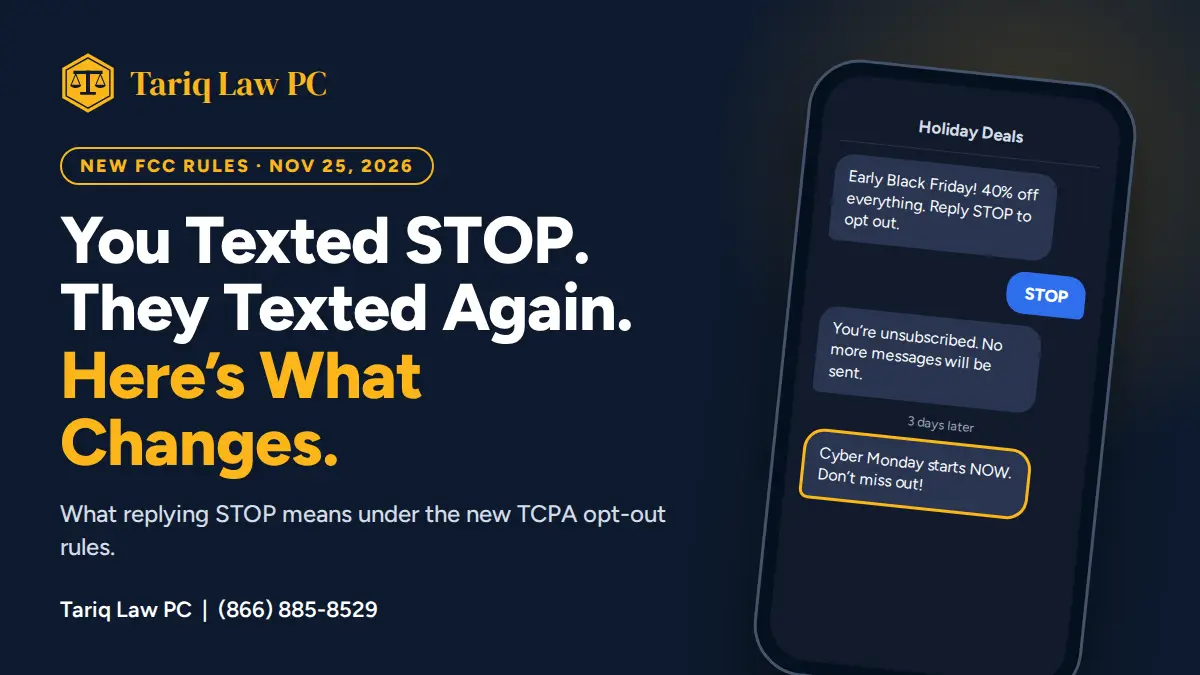
You Texted STOP. They Texted Again. Here’s What Changes on November 25
You know the moment. A sale text pops up. You don’t want it, so you type four letters: STOP. You get a polite reply saying you’ve been unsubscribed.
Then, a few days later, your phone buzzes again. Same company. New deal.
If that has happened to you, you’re not imagining it, and you’re not alone. “Replied STOP, still getting texts” is one of the most common complaints about marketing messages. And with Black Friday, Cyber Monday and holiday sales about to flood every phone in America, it’s about to get worse.
Here’s the timing that matters: new federal opt-out rules take effect on November 25, 2026, the day before Thanksgiving. They change how some companies can handle your STOP. In this guide, we’ll explain in plain English what changed, what didn’t, what texting STOP means for you now, and when unwanted texts may cross the line into a violation of the law.
First, Why Does Texting STOP Even Matter?
The Telephone Consumer Protection Act (TCPA) is the federal law that limits robocalls, prerecorded calls and many automated texts. Think of it as your phone’s “do not disturb” sign, written into federal law.
Under the TCPA, many companies need your permission (your “consent”) before they send certain automated calls and texts. Replying STOP is how you take that permission back. Lawyers call this revoking consent.
Why does that matter? Because once you clearly take your consent back, messages that keep coming may no longer be allowed. And the TCPA isn’t just a suggestion. The law sets damages of $500 per violation, and up to $1,500 when a violation is knowing or willful. Whether you have a claim depends on the facts, such as what kind of messages they were and how they were sent.
New Yorkers have an extra layer of protection too. Since 2021, New York’s telemarketing law has covered marketing texts, not just calls. You can read more on our TCPA robocalls and unwanted texts page.
What Actually Changes on November 25, 2026
On October 26, the Federal Communications Commission (FCC) published its revised opt-out rules in the Federal Register. They take effect November 25, 2026. Here are the three changes that matter most to you, in plain English.
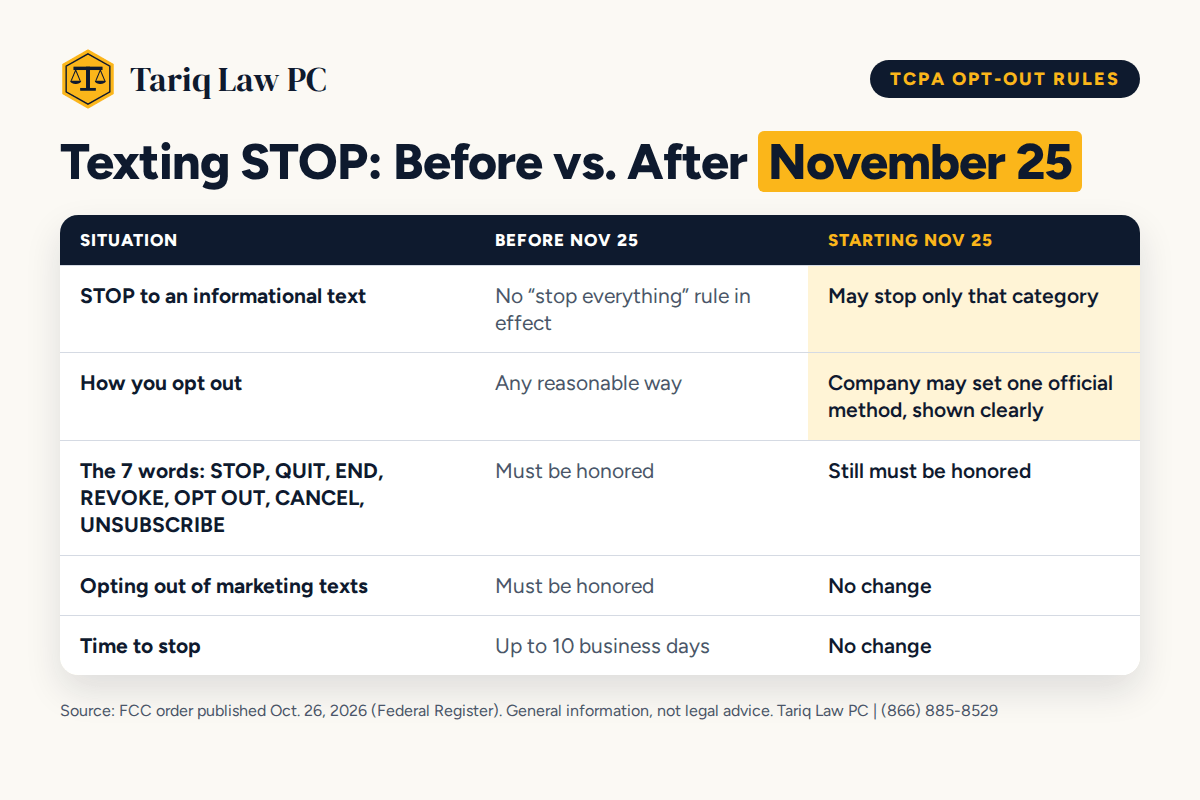
1. Your STOP may only cover one “type” of informational message
Some texts aren’t ads. They’re informational: payment reminders, appointment notices, account alerts, fraud warnings. Under the new rule, if you reply STOP to one kind of informational message, the company may treat your opt-out as covering only that category.
For example, replying STOP to a payment reminder might stop the reminders, while the company keeps sending you fraud alerts. The FCC said it made this change partly so people don’t accidentally cut off alerts they still want.
What this means for you: if you want everything from a company to stop, say so clearly, for example: “STOP all messages.” Then watch what comes next.
2. Companies can pick the “official” way you opt out
Before, you could opt out in almost any reasonable way: a reply text, a phone call, even an email. Now, companies may name an exclusive opt-out method, such as replying by text, a phone number or a website.
There’s a catch for the company: it must tell you about that method clearly and conspicuously in the call or text. If it doesn’t, it still has to honor your opt-out made in any reasonable way.
3. The seven magic words still work
Even when a company makes reply texts its only opt-out method, it must still honor any of these seven words: STOP, QUIT, END, REVOKE, OPT OUT, CANCEL, UNSUBSCRIBE. A company can list just one of them (usually “Reply STOP”), but it can’t ignore the other six.
What did NOT change
Marketing and telemarketing texts: the opt-out rules for ads and sales messages stay the same.
The deadline to stop: companies generally have no more than 10 business days to honor your request. The FCC is now asking whether that window should be shorter.
The bigger fight isn’t over: the FCC is also asking whether companies that split opt-outs by category should have to offer a simple one-step way to stop all messages. Public comments are due November 25, with replies due December 28.
Before vs. After November 25: The Quick Version
STOP Lawsuits Are Making Headlines This Fall
Ignored STOP requests aren’t just a pet peeve. In the past few months, several big-name companies have been hit with proposed class actions claiming exactly that. These are allegations only. None of these companies has been found liable, and the cases are still at an early stage.
AT&T: a proposed class action alleges AT&T kept texting a customer after she asked it to stop. According to the complaint, when she replied in plain words asking for no more messages, an automated reply said it didn’t understand her.
LA Fitness: a complaint filed in September 2026 alleges marketing texts kept coming after a STOP reply.
TikTok: a proposed class action in Los Angeles federal court alleges marketing texts resumed after the recipient replied STOP and got a confirmation.
Notice the pattern? Each complaint points to specifics: who sent the texts, when the person opted out, and which messages arrived afterward. That kind of record is what turns a frustrating experience into something a lawyer can actually evaluate.
How to Opt Out the Right Way (and Protect Yourself)
With Black Friday deals already landing in inboxes, here’s a simple game plan you can use today.
Read the message first. Look for the opt-out instruction, such as “Reply STOP to unsubscribe.” After November 25, that instruction may be the company’s official method, so use it.
Use one of the seven words. STOP is the safest choice. If you want every message to end, add “all”: “STOP all messages.”
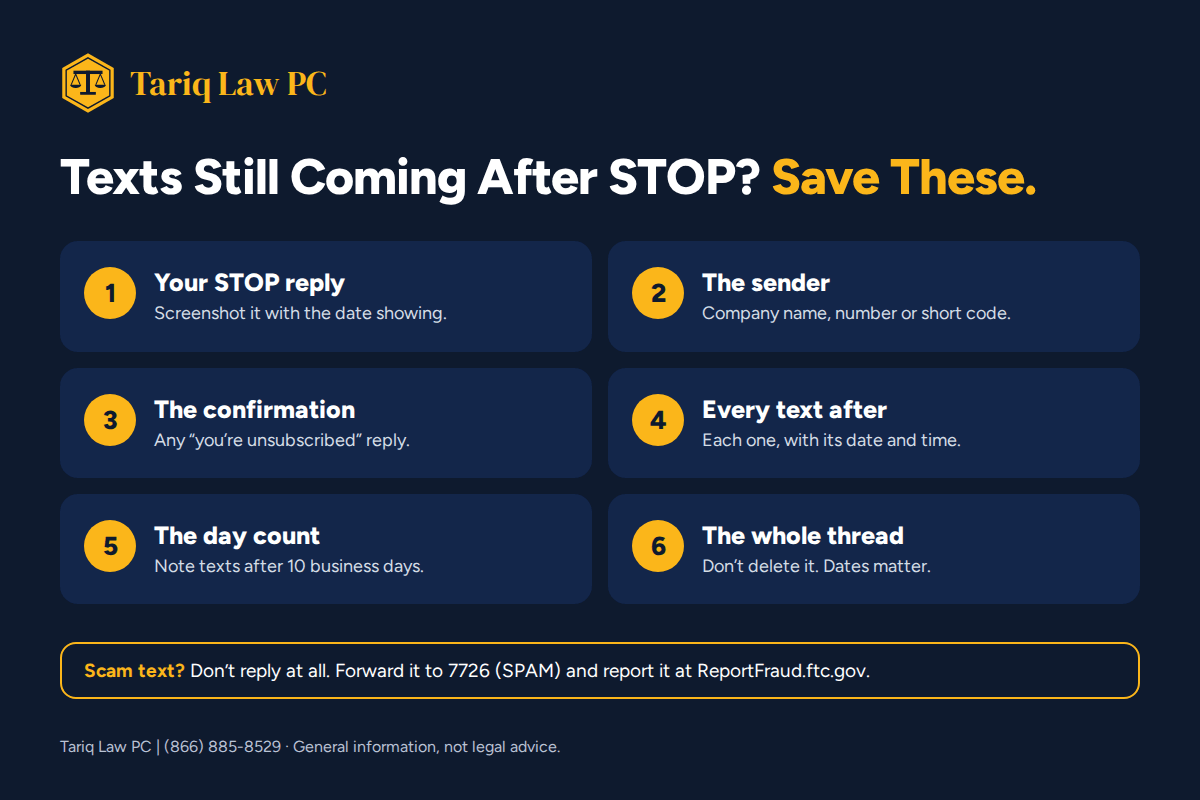
Screenshot your STOP. Capture the sender’s name or number, the date and your reply.
Save the confirmation. A one-time reply confirming your opt-out is normal. Ongoing promotions after that are not.
Count the days. Companies generally have up to 10 business days to stop. Note the date of every message that arrives after that.
Don’t delete the thread. Deleted texts are hard to get back, and the dates matter.
One big exception: scam texts
All of this applies to real companies you’ve done business with. Scam texts are different. The FTC advises not replying to suspicious texts at all, not even with STOP, because a reply can confirm your number is active. Instead, forward the scam text to 7726 (SPAM) and report it at ReportFraud.ftc.gov.
If a scam text already cost you money this season, our guide on holiday shopping scams and how to get your money back walks you through your next steps.
When Should You Talk to a TCPA Lawyer?
One stray text after you opt out is annoying. A pattern is something else. It may be time to get a lawyer’s review when:
You replied STOP (or another of the seven words) and the texts kept coming well past 10 business days
You never signed up, and automated texts or prerecorded calls keep arriving
The company ignored your opt-out because you didn’t use its “official” method, and that method was never clearly shown in the message
A debt collector keeps texting or calling after you asked it to stop. That may raise issues under the TCPA and the FDCPA. If you’ve been sued over the debt, read about debt collection lawsuit defense before you respond.
Unwanted texts often travel with other problems. Spam can follow a data breach or identity theft, and our identity theft and fraud page explains your options. If fraud has left accounts you don’t recognize on your report, see our credit reporting errors page. And if money left your bank account without your OK, learn your rights under the Electronic Fund Transfer Act.
At Tariq Law PC, we’re a consumer protection law firm in New York City, not a credit repair company. We focus on federal consumer laws, including the TCPA, FCRA, FDCPA and EFTA, and we serve New York City and the Tri-State area. We offer free case evaluations for qualified matters. Results depend on the facts of each case.
Frequently Asked Questions
1. I replied STOP. Why am I still getting texts?
A single confirmation text right after you opt out is normal. Beyond that, a company generally has up to 10 business days to process your request. If texts keep coming after that, the company may not be honoring your opt-out. Starting November 25, check whether your STOP covered only one category of informational messages. Then screenshot everything.
2. How long does a company have to stop texting me after I reply STOP?
Generally, no more than 10 business days. The new rules don’t change that deadline, although the FCC is asking whether it should be shorter.
3. Can I sue a company for texting me after I said STOP?
Possibly. The TCPA sets damages of $500 per violation, and up to $1,500 for knowing or willful violations. Whether you have a claim depends on the type of messages, how they were sent and when you opted out. A TCPA lawyer can review your screenshots and tell you whether you may have options.
4. Does replying STOP to a spam text make it worse?
It can, if the text is a scam. The FTC advises not replying to suspicious texts at all, because a reply can confirm your number is active. Forward scam texts to 7726 (SPAM) and report them at ReportFraud.ftc.gov. For real companies you’ve done business with, replying STOP is the right move.
5. Do the new rules let companies ignore my STOP?
No. Companies must still honor STOP, QUIT, END, REVOKE, OPT OUT, CANCEL and UNSUBSCRIBE. What changed is that an informational opt-out may cover only one category of messages, and companies may name an official opt-out method if they disclose it clearly. Opt-outs from marketing and sales texts work the same as before.
Attorney Advertising. This article is for general informational purposes only and is not legal advice. TCPA coverage depends on the facts, sender, consent, technology, exemptions, and jurisdiction. Past results do not guarantee a similar outcome. Free case evaluations are available for qualified matters. Attorney review pending.


