Holiday Shopping Scams: Get Your Money Back | Tariq Law
Be honest: have you ever gotten a text saying your package couldn't be delivered, when you weren't even sure which package it meant?
If so, you've already met the most popular scam of the holiday season. And if you've ever tapped that link, typed in your card number "just to fix it," and felt your stomach drop a few minutes later, you know exactly how convincing these messages can be.
Here's the frustrating part: these scams don't work because people are careless. They work because the timing is perfect. In the weeks before Thanksgiving, most of us are ordering gifts from several websites and waiting on several deliveries. A message about a delivery problem looks completely normal.
The good news is that you have more rights than most people realize, and you don't have to figure this out alone. Here's how holiday shopping fraud really works, what to do the moment you spot it, and when it makes sense to call a lawyer.
Why November Is Scammers' Favorite Month
Holiday shopping scams work for one simple reason: timing. In late November, everyone is expecting a package. Everyone is hunting for a deal. Everyone is a little rushed.
Scammers know the calendar better than you do. From Black Friday and Cyber Monday through early January, they flood phones and inboxes with fake delivery texts, fake order confirmations, and "too good to be true" sales. A McAfee survey found that 36% of Americans said they had been a victim of an online shopping scam during the holiday season, and about half of those victims said it cost them $100 or more.
Here are the most common traps this year:
The fake delivery text (package delivery scam). A message claims your parcel is stuck and asks you to click a link, pay a small fee, or "confirm" your details. The link goes to a copycat site that steals your card number or login. The Federal Trade Commission says legitimate companies won't ask you to do this by text.
The fake online store. A slick site sells hot items for 70% off. You pay. Nothing arrives, and your card details are now in a stranger's hands.
Social media shopping ads. They look real, with fake reviews and borrowed photos. Same ending.
Peer-to-peer payment scams (Zelle and similar apps). Someone tricks you into sending money, then it's gone. New York's Attorney General has sued Zelle's operator over fraud on the platform, which shows how common this problem has become.
Gift card and "urgent request" scams. A text from a "boss" or "family member" asks you to buy gift cards right now.
"I Got Scammed. Is My Money Gone for Good?"
Not necessarily. Many people give up too early because they assume the bank will say no. Federal law gives you real protections, but the rules depend on what kind of card or account was used, and how fast you act.
If it was a credit card
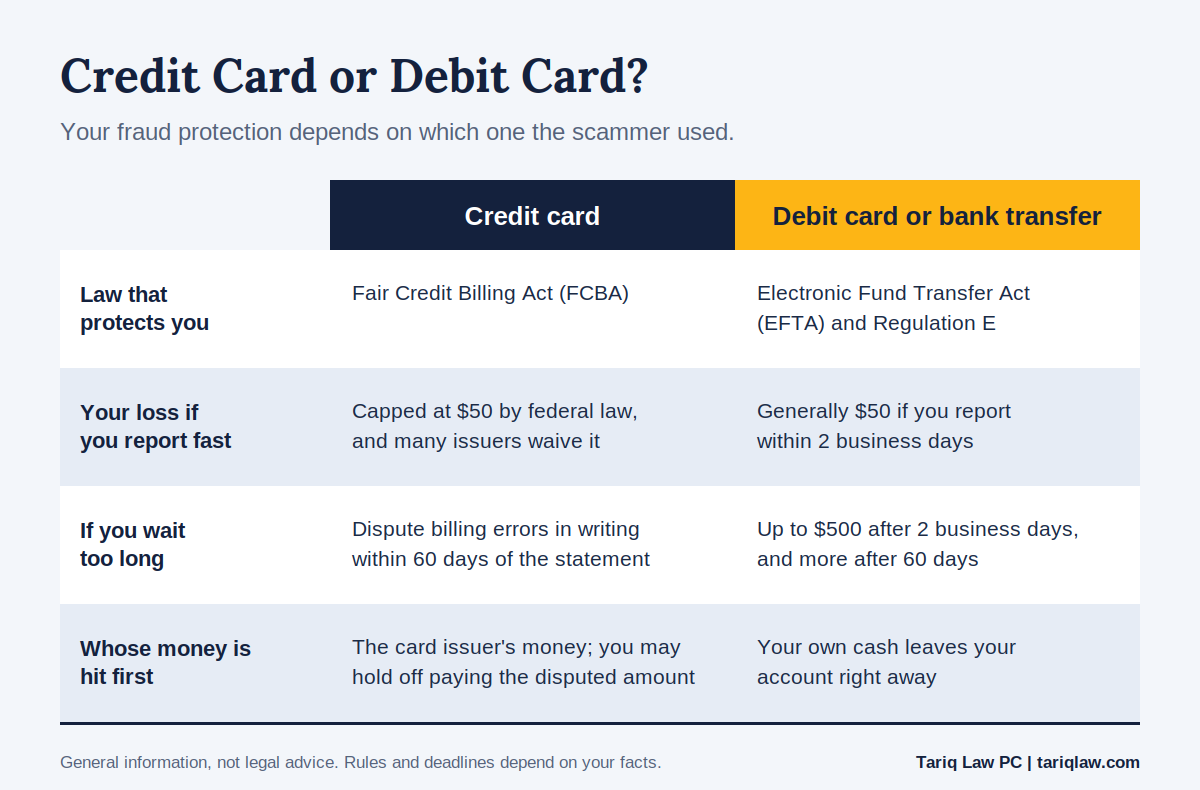
The Fair Credit Billing Act (FCBA) protects you from billing errors and unauthorized charges. In simple terms:
•Your liability for unauthorized credit card use is capped by federal law at $50, and many card issuers waive even that.
•To formally dispute a billing error, you generally must notify the card issuer in writing within 60 days of the statement that first showed the problem.
•While the issuer investigates, you can usually hold off paying the disputed amount.
This is why many consumer advocates say credit cards are safer than debit cards for online shopping. It's also what people mean when they search "how to dispute a fraudulent charge" or "credit card fraud dispute."
If it was a debit card or bank transfer
The Electronic Fund Transfer Act (EFTA) and its rule, Regulation E, cover unauthorized electronic transfers from your bank account. Speed matters a great deal here:
•Report within two business days of learning about the problem, and your loss is generally limited to $50.
•Report later, and your potential loss can climb to $500.
•Wait more than 60 days after the statement that shows the charge, and you could be on the hook for much more.
That's the hard truth about debit card fraud refunds. The lesson: the day you spot a suspicious charge, call your bank. Your protections are strongest when you act right away, and they may shrink if you wait until January.
If your money has disappeared from your bank account, read about your rights under the Electronic Fund Transfer Act.
The tricky one: when you sent the money
If a scammer tricks you into sending the payment yourself, banks often argue it was "authorized" and refuse to refund. Whether the law actually requires a refund in your situation depends on the details: how the transfer happened, what the bank knew, and what safeguards it used. This is exactly the "my bank won't refund fraud" situation where a lawyer's review can matter.
What To Do in the First 24 Hours
If you think you've been scammed, do these things today:
1.Call your bank or card issuer using the number on the back of your card. Say the words "unauthorized charge" or "fraud." Ask them to freeze the card and open a dispute. Write down the date, time, and name of the person you spoke with.
2.Put it in writing. Follow up by letter or secure message, especially for credit card billing errors. Keep copies.
3.Take screenshots. Save the text, the website, the order page, and the statement lines. Scammers delete things fast.
4.Don't click anything else. Don't reply to the text and don't call numbers it gives you.
5.Change your passwords on your bank, email, and shopping accounts. Turn on two-factor authentication.
6.Freeze your credit. Credit freezes and fraud alerts are free by federal law, and they stop thieves from opening new accounts.
7.Report it. File a report at ReportFraud.ftc.gov, and if your identity was used, at IdentityTheft.gov.
When a Scam Becomes Something Bigger
If a scammer used your details to open new accounts, you may find unfamiliar loans or cards on your credit report weeks later. If you're dealing with accounts you don't recognize, our page on identity theft and fraud explains your options. If those errors stay on your report after you dispute them, you may have claims under the Fair Credit Reporting Act, which we cover on our credit reporting errors page.
And if a debt collector later chases you for something a thief created, don't answer on your own. Missing a court deadline can lead to a default judgment, so learn about debt collection lawsuit defense before you respond. Scam victims also often get flooded with spam calls and texts afterward. Repeated unwanted messages may violate the TCPA.
Spot the Fake Before You Tap
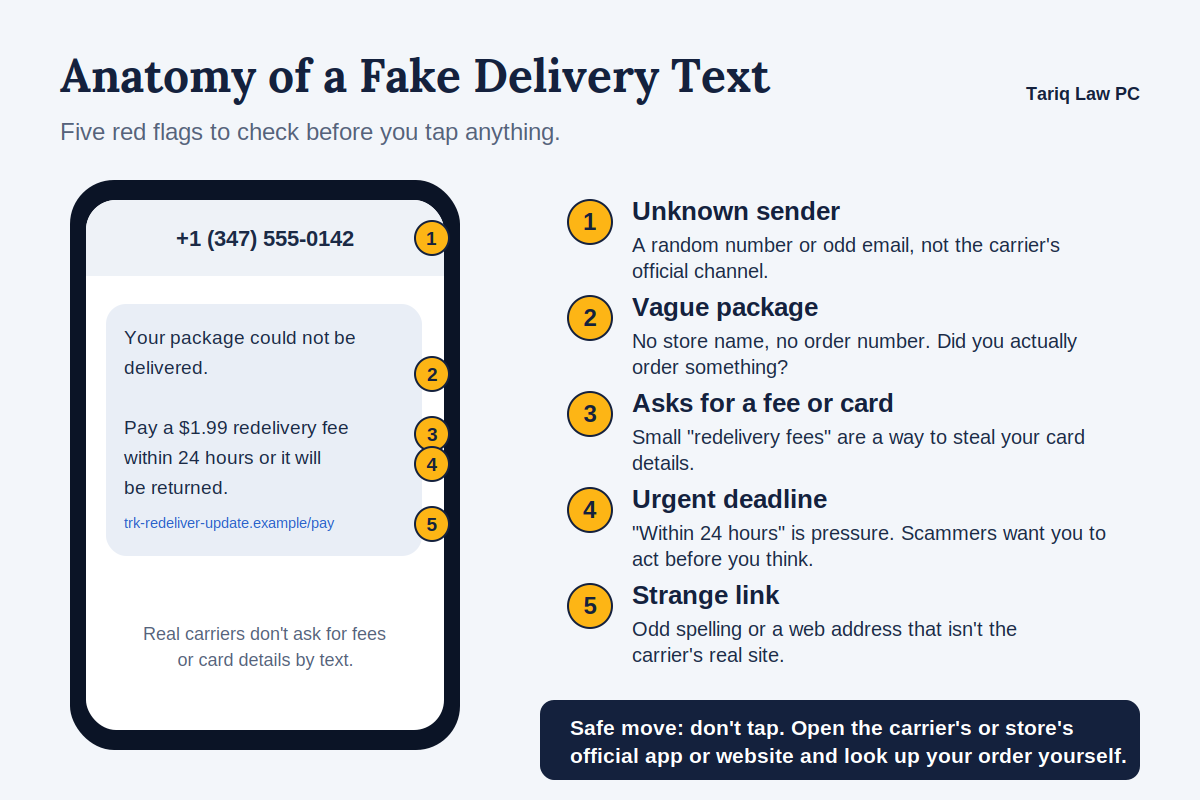
A quick checklist before you click anything this season:
•Did you actually order something that matches this message? If not, ignore it.
•Is it urgent, threatening, or too good to be true? That's the scammer's favorite trick.
•Does the link look slightly off, with odd spellings or a strange web address?
•Does it ask for a fee, a gift card, or your card details by text? Real carriers don't.
•Safest move: open the carrier or retailer's official app or website yourself, and look up the order there.
When Should You Call a Consumer Protection Lawyer?
Most simple fraud disputes get resolved with a phone call and a letter. But it may be time to get legal help when:
•Your bank or card issuer denied your fraud claim and you believe the law was on your side
•The fraud caused errors on your credit report that won't go away
•You were sued, or a collector is chasing you for a fraudulent account
•You lost a large amount and deadlines are close
At Tariq Law PC, we're a consumer protection law firm in New York City, not a credit repair company. We focus on federal consumer laws including the FCRA, FDCPA, EFTA, and TCPA, and we serve New York City and the Tri-State area. We offer free case evaluations for qualified matters.
Frequently Asked Questions
1. Can I get my money back if I was scammed shopping online?
Often, yes, especially if you paid by credit card. The Fair Credit Billing Act lets you dispute unauthorized charges and billing errors, and debit card fraud falls under Regulation E. Your chances depend on the payment type, how quickly you report, and whether the transaction was "unauthorized." Report it right away.
2. How long do I have to dispute a fraudulent credit card charge?
For a formal billing error dispute under the FCBA, you generally have 60 days from the date of the statement that first showed the charge. Some issuers allow longer through their own policies, but don't count on it. Call as soon as you notice.
3. Does my bank have to refund unauthorized debit card charges?
Under the Electronic Fund Transfer Act, banks must investigate unauthorized electronic transfers, and your liability is limited if you report promptly (generally $50 within two business days, rising to $500 after that, and potentially more if you wait more than 60 days). If your bank refuses, you may want to speak with a lawyer.
4. I clicked a fake delivery text link. What should I do now?
Don't enter anything else. Contact your bank to freeze your card, change your passwords, turn on two-factor authentication, place a free credit freeze, and report the text to the FTC at ReportFraud.ftc.gov. Then watch your statements and credit reports closely for the next few months.
5. Can I get my money back from a Zelle scam?
It's harder, because the transfer is instant and banks often treat it as "authorized" if you sent it yourself. But it's not hopeless, particularly if someone accessed your account without your permission. Contact your bank immediately, file reports with the FTC and police, and consider legal advice about your situation.


