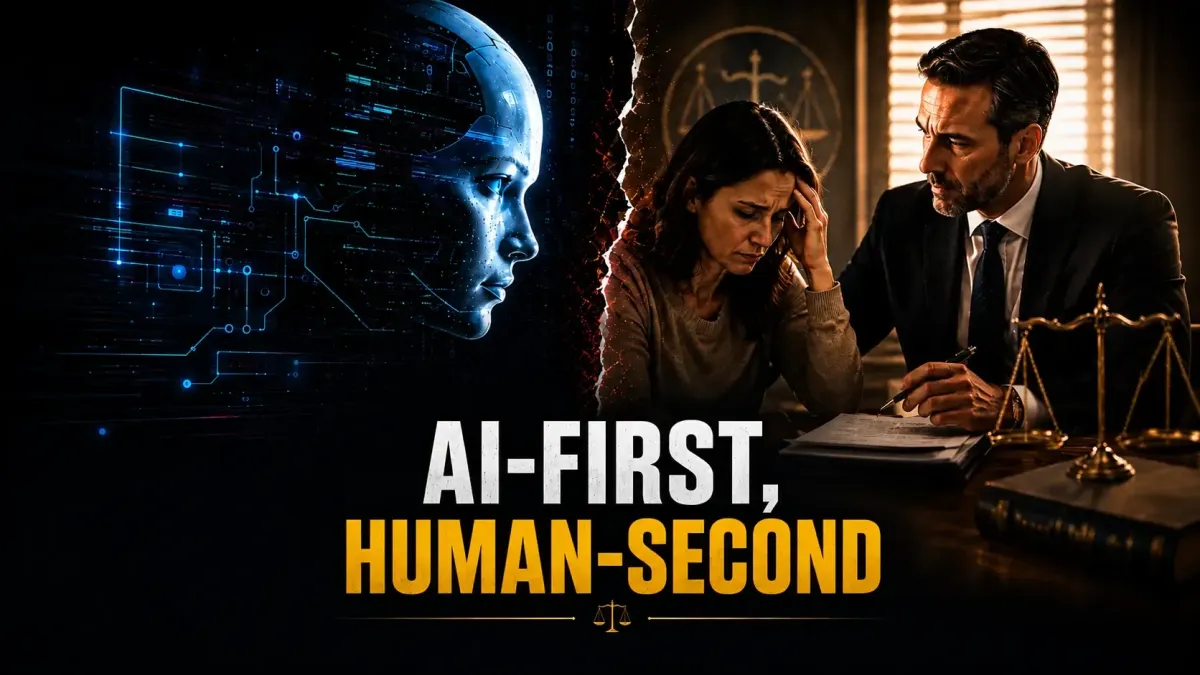
AI-First, Human-Second: Why Customer Service Got Worse and How Tariq Law PC Do It Differently
You've felt it, even if you've never put words to it.
The chatbot that loops you back to the same three menu options. The "resolution" email that clearly never read what you wrote. The support agent who, when you finally reach one, seems to be reading from the same script the machine already ran. You explain your problem. Nothing changes. The answer feels like it was decided before you opened your mouth.
That's not an accident. It's a design choice. More and more companies have gone AI-first and human-second — and it shows.
What "AI-first, human-second" actually costs you
There's nothing wrong with automation. Used well, it's a genuine help. The problem is what happens when a company stops using AI to serve people and starts using it to manage them.
In an AI-first system, the machine makes the call. A human might get involved later but usually only to confirm what the algorithm already decided. Instead of a real second look, you get a rubber stamp. The person isn't there to reconsider your case. They're there to close the ticket.
For an annoying return or a late package, that's frustrating. When it touches your money, your credit, or a lawsuit against you, it's something much more serious.
Where this quietly hurts consumers
Here's what most people don't realize: the "AI reinforcing what AI already decided" problem isn't just bad customer service. In the financial world, it's how real harm happens.
Your bank denies a fraud dispute. You report an unauthorized transaction, and an automated review kicks it back, often without a person ever examining the facts you provided.
A credit bureau "verifies" an error. You dispute an account that isn't yours, and an automated system confirms it as accurate in seconds, leaving the mistake on your report.
A debt collector pushes a lawsuit built on records that were processed in bulk, with little individual human attention to whether the details are even correct.
In each case, a decision that can damage your finances gets made and then re-confirmed with barely a human in the loop. The machine's first answer becomes the machine's final answer.
That's exactly the pattern that leaves consumers stuck. And it's a big part of why we built our firm the way we did.
At Tariq Law PC, it's human-first — AI-enabled
We use AI. We're not going to pretend otherwise, and we're not going to ignore a tool that helps us serve people better. But we use it in a specific, deliberate way: to move faster, not to decide for us.
AI helps our team organize information, surface details, and cut the busywork that used to slow cases down. That means we can respond quicker and spend more of our time on the part that actually matters, your situation, your facts, and the options in front of you.
What it does not do is take the human out of the decision. That's the whole point.
AI should assist, not judge
In legal matters, we believe AI belongs in an assistive role, a tool that can help lawyers and judges work more efficiently and never a tool that reaches conclusions or hands down judgments on its own.
There's a meaningful difference between a tool that helps a person think and a tool that thinks for them. A calculator helps you do math; it doesn't decide what your budget should be. In the same way, AI can help a legal team work through information faster, but the reasoning, the judgment, and the responsibility stay where they belong: with a human being.
Every AI-assisted output gets human review
This is the commitment behind the philosophy.
At our firm, any output produced with the help of AI, even in a purely assistive capacity gets thorough human review before it means anything. A person reads it. A person checks it. A person is accountable for it.
We do this because the risks of skipping it are real. AI can be confidently wrong. It can miss context, misread a detail, or produce something that looks polished but isn't right for your case. Human review isn't a formality we tack on at the end. It's the safeguard that makes the tool usable at all.
Technology can accelerate a decision. A human being makes it.
The bottom line
When companies go AI-first, you become the thing being processed. When people come first, you become the thing being helped.
At Tariq Law PC, we chose people. We use technology to be faster and sharper, but the judgment, the review, and the responsibility are always human. Because when your credit, your bank account, or a lawsuit against you is on the line, you deserve more than a machine's best guess. You deserve someone who actually looked.
Dealing with a debt lawsuit, a credit report error, a debt collector, or an unauthorized bank transaction that a company brushed off?
Tariq Law PC can review your situation and help you understand your options — with real people, not a script.


