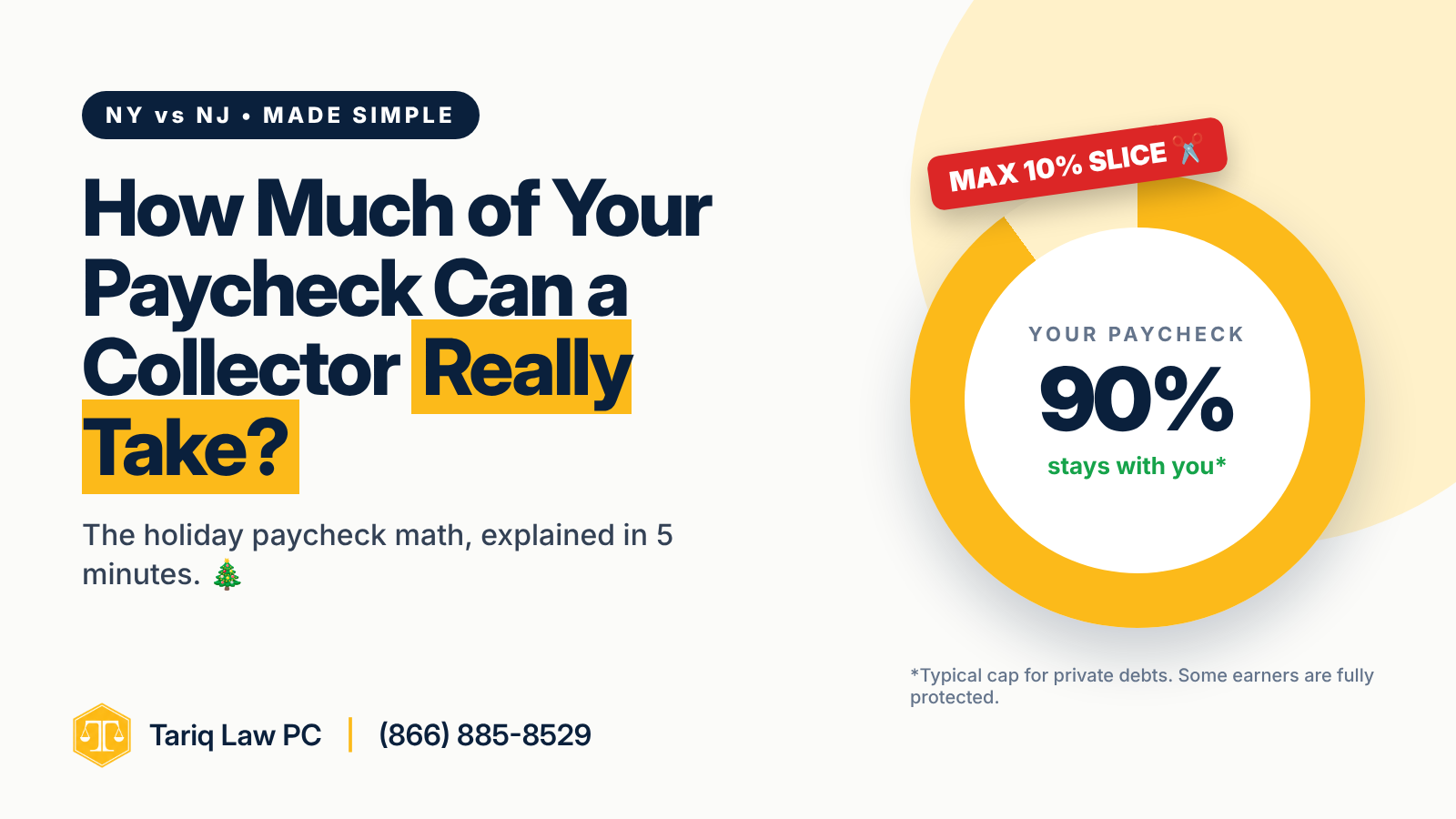
How Much of Your Paycheck Can a Collector Really Take? New York’s Rules, Explained
You know the moment. It's the holidays, and everyone wants a slice of your paycheck. Rent wants a slice. Gifts want a slice. That cousin who "forgot his wallet" at dinner wants a slice.
Then a debt collector shows up with a court judgment and asks for a slice too.
Here's what most people don't know: the law decides how big that slice can be. A collector can't just take whatever it wants. In New York and New Jersey, there are clear caps, and some workers are protected completely.
Let's do the paycheck math together. No law degree needed.
First, why do garnishment limits matter?
Because a lot of people assume a collector can drain their whole check. That fear leads to panic payments, payday loans, or agreeing to deals they can't afford.
Wage garnishment means a creditor takes part of your pay straight from your employer. In New York it's called an income execution. In New Jersey it's a wage execution. Either way, it usually only happens after a creditor wins a court judgment, often a default judgment when someone didn't respond to a lawsuit. (Never knew you were sued? Read our guide to ghost lawsuits and default judgments in NY.)
Knowing the limits helps you spot two things fast:
Is the amount being taken legal? Mistakes happen, especially with overtime and holiday pay.
Are you one of the people the law fully protects? Lower earners in New York may owe nothing from their paycheck at all.
Fun fact: two words do most of the work in garnishment math. Gross pay is your pay before anything comes out. Disposable pay is what's left after legally required deductions like taxes and Social Security. Collectors often only talk about the first one.
The rules, made simple: New York vs. New Jersey
New York takes the smaller of two numbers. A creditor can take up to 10% of your gross pay or 25% of your disposable pay, whichever is less. (New Economy Project)
New York has a "safe zone." If your disposable pay is $510 a week or less in NYC (based on the 2026 $17 minimum wage), none of your wages can be garnished for a private debt. Outside NYC, Long Island and Westchester, the number is a bit lower because the minimum wage is lower. Garnishment also can't push your weekly take-home below that line.
New Jersey generally caps it at 10% of gross pay. That limit is in N.J.S.A. 2A:17-56. Higher earners can face more in some cases, and federal law adds a ceiling of 25% of disposable pay for everyone. (Nolo)
Two garnishments don't double the damage in NY. If two creditors have judgments, the second one usually has to wait until the first is paid off.
Some money is off-limits. Social Security and many other benefits are generally protected from private debt collectors. In New York, a health care provider can't garnish your wages for medical debt.
Your job is protected. In both states, an employer generally can't fire you because of a wage garnishment.
What did NOT change
The debt doesn't shrink on its own. A garnishment keeps going until the judgment is paid, settled, or undone.
Interest and costs can still be added to the judgment amount.
Child support, taxes and government student loans follow different rules. This article only covers private consumer debts like credit cards and personal loans.
Let's do the paycheck math
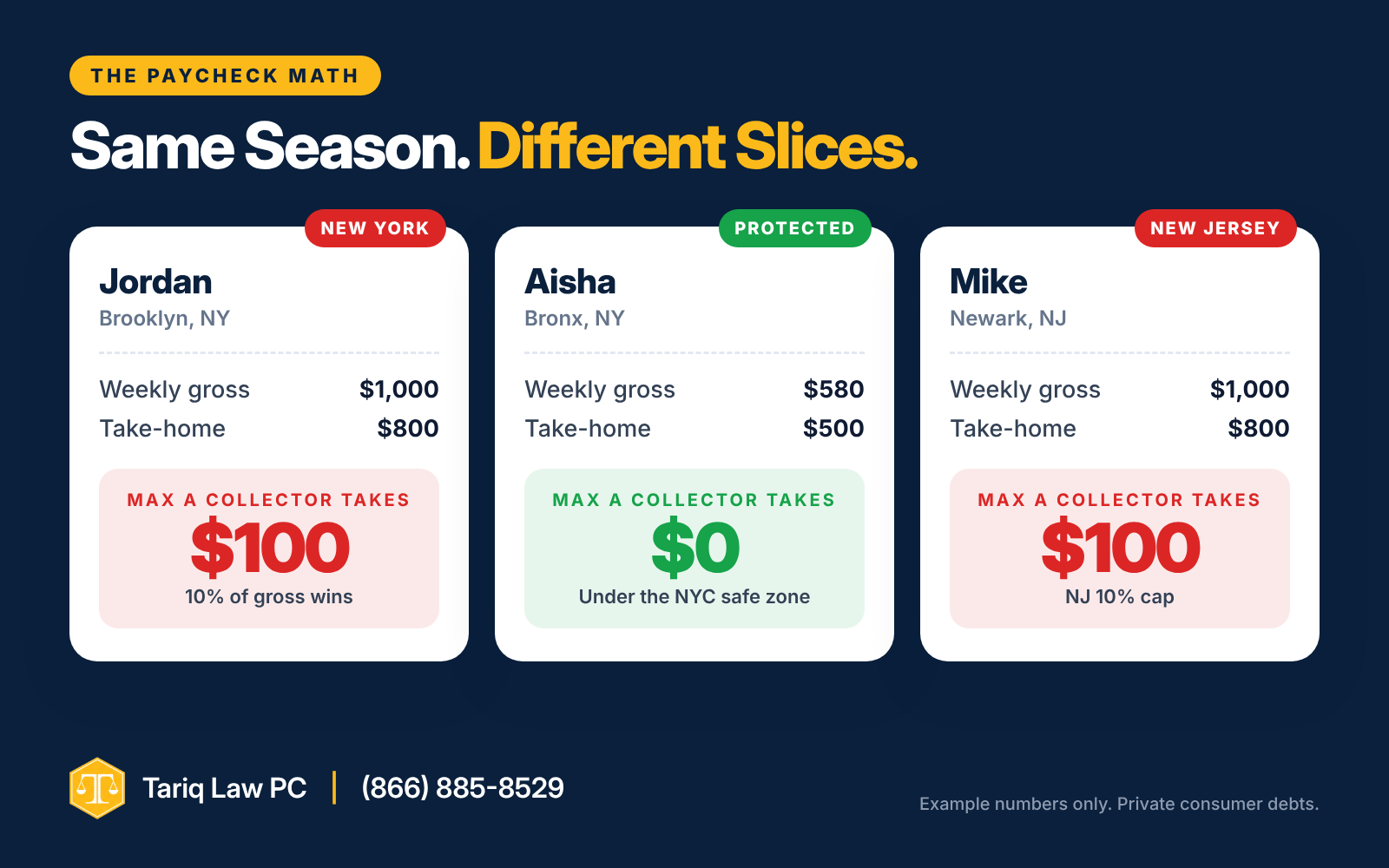
Meet three workers. Same holiday season, very different slices. (Example numbers only; your real amount depends on your pay and deductions.)
Worker | Weekly gross | Weekly disposable | Max a collector can take |
|---|---|---|---|
Jordan (Brooklyn, NY) | $1,000 | $800 | $100 (10% of gross is smaller than 25% of disposable) |
Aisha (Bronx, NY) | $580 | $500 | $0 (under the $510 NYC safe zone) |
Mike (Newark, NJ) | $1,000 | $800 | Up to $100 (NJ's 10% cap) |
See Aisha? She's fully protected, but only if someone checks. Employers and collectors don't always get it right, especially when holiday overtime bumps one paycheck up.
Your paycheck is being garnished. Now what?
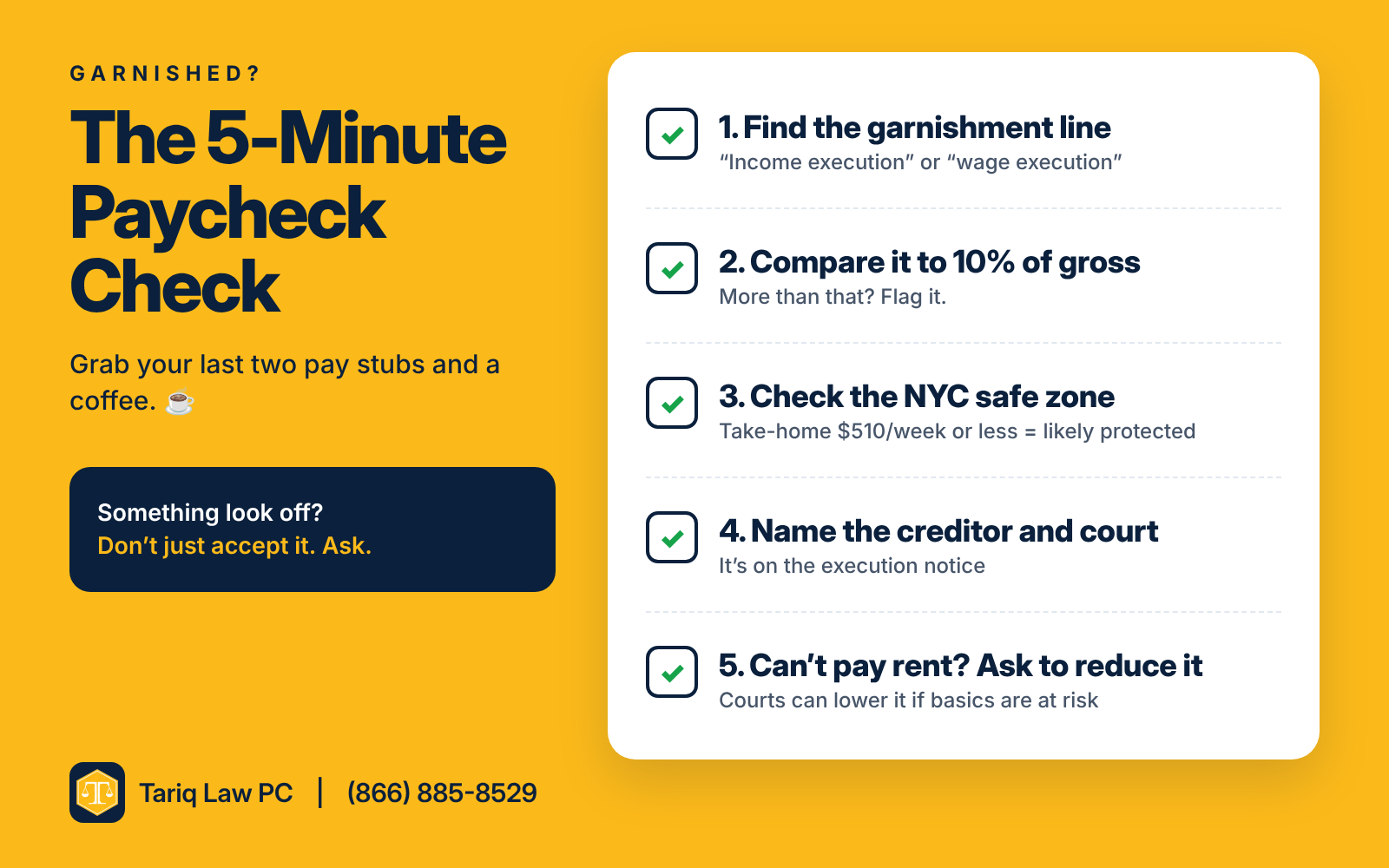
Grab your last two pay stubs. Find the garnishment line and the amount. Compare it to 10% of your gross pay.
Do the safe-zone check. In NYC, is your weekly take-home $510 or less? If yes, your wages may be fully protected.
Find out who's taking it. The income execution or wage execution names the creditor, the court and the judgment amount.
Ask for a reduction if you can't cover basics. In New York, you can ask the court to lower the amount if it leaves you unable to pay for rent, food, utilities or medical care. In New Jersey, you can object or ask for a hearing.
Keep every paper. Pay stubs, notices, letters and bank statements help prove what was taken.
One big exception
If the judgment itself is wrong, fighting the garnishment amount isn't enough. If you were never properly served, the debt isn't yours, or the debt was too old to sue on, the better move may be to challenge the judgment itself. If it's vacated, the garnishment can stop.
When should you talk to a lawyer?
Get help quickly if:
More than 10% of your gross pay is being taken for a credit card or personal loan debt.
Your take-home is already near the safe zone, and you're still being garnished.
You're being garnished and your bank account is frozen at the same time.
You don't recognize the creditor or never knew about the lawsuit.
A collector is threatening your job or telling you garnishment has no limit.
A consumer protection lawyer can check the math, ask the court to lower or stop the garnishment, and look at whether the judgment can be challenged. They can also check whether the collector broke debt collection laws, like calling more than the NYC limit. Learn more about how we defend debt collection lawsuits.
FAQs
1. How much of my paycheck can be garnished in New York? For private debts like credit cards, generally the smaller of 10% of your gross pay or 25% of your disposable pay. If your disposable pay is $510 a week or less in NYC, your wages are generally protected.
2. How much can be garnished in New Jersey? New Jersey generally caps wage executions for consumer debts at 10% of gross pay. Federal law also limits garnishment to 25% of disposable earnings.
3. Can two creditors garnish my wages at the same time in NY? Usually not at full strength. The first creditor generally takes the maximum, and the second has to wait until the first is paid off.
4. Can my employer fire me because of a garnishment? Generally, no. Both New York and New Jersey protect workers from being fired because of a wage garnishment.
5. Can I get a garnishment reduced? Possibly. If the amount leaves you unable to pay for basics like rent, food, utilities or medical care, you can ask the court to lower it. If the judgment itself was wrong, you may be able to challenge it and stop the garnishment.
Attorney Advertising. This article is for general informational purposes only and is not legal advice. Garnishment limits change with the minimum wage and depend on your income, your county and the type of debt. Example numbers are illustrations only. Contacting Tariq Law PC does not create an attorney-client relationship. Prior results do not guarantee a similar outcome.


