
Your Debt Might Be Too Old to Sue On. Here's How to Tell in New York and New Jersey.
You know the moment. You're cleaning out a drawer, or scrolling past a voicemail, and there it is: a letter about a credit card you stopped paying back when you still had a MetroCard. Now a company you've never heard of wants the money. With interest.
Here's what most people in New York and New Jersey don't know: debt can get too old to sue on. Like milk in the fridge, it has an expiration date. And in New York, that date comes faster than you'd think.
If the clock has run out, a debt collector may not be allowed to take you to court at all. Here's how it works on both sides of the Hudson.
First, What Is a Statute of Limitations on Debt?
It's a legal deadline. A creditor or debt collector only has a set amount of time to sue you over an unpaid debt. Once that time runs out, the debt becomes "time-barred."
Two things to know right away:
Time-barred doesn't mean erased. The debt may still exist, and collectors may still contact you about it. They just can't win a lawsuit over it if you raise the defense.
The clock usually starts from your last payment or account activity, not from the day you opened the card.
Under the federal Fair Debt Collection Practices Act, suing or threatening to sue on a time-barred debt can itself be an illegal collection practice.
New York vs. New Jersey: How Long the Clock Runs
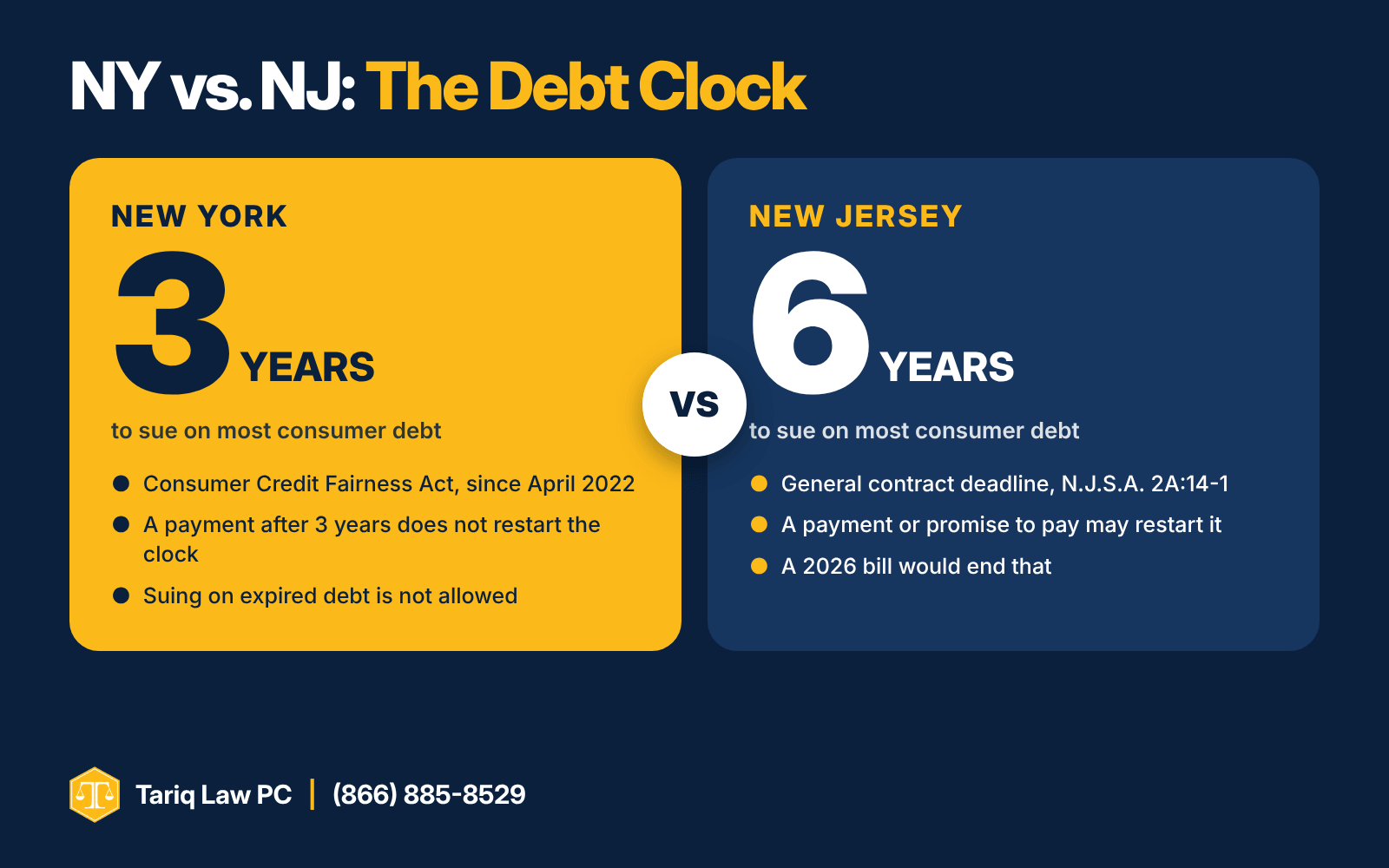
New York: 3 years
Since April 7, 2022, New York's Consumer Credit Fairness Act gives collectors 3 years to sue on most consumer credit debt, like credit cards and personal loans. It used to be 6.
Even better: in New York, a payment made after the 3 years are up can't bring an expired debt back to life. Collectors also can't sue, or threaten to sue, on debts older than that.
New Jersey: generally 6 years
New Jersey generally gives collectors 6 years to sue on contract debts like credit cards, under N.J.S.A. 2A:14-1.
The catch: under current New Jersey case law, a payment, an acknowledgment of the debt or a new promise to pay can restart the clock, even on an old debt. That's exactly why a pending 2026 bill, Assembly Bill A1415, would stop expired consumer debts from being revived that way. It hasn't passed yet.
Fun (and Useful) Facts About Old Debt
New York cut its deadline in half. Before April 2022, collectors had 6 years. Now most consumer credit debt expires for lawsuits in 3. That's shorter than most car leases.
Cross the Hudson, double the clock. A credit card debt that's too old to sue on in Manhattan may still be fair game in Hoboken, where the deadline is generally 6 years.
Debt buyers often pay pennies on the dollar. Old accounts are bundled and sold, sometimes more than once. The older the debt, the harder it can be for the buyer to prove it owns it, or how much you owe.
NY collectors must show their homework. In New York, a debt lawsuit has to name the original creditor, the last 4 digits of the account, the date of your last payment and an itemized balance. (NY AG)
What did NOT change
An old debt can still be collected by phone or letter. The deadline mostly protects you from lawsuits.
A judgment a collector already won is a different story. It can last much longer than the original debt.
The clock can be different for some types of debt, like debts secured by property. Check your situation with a lawyer.
How to Tell If Your Debt Is Too Old
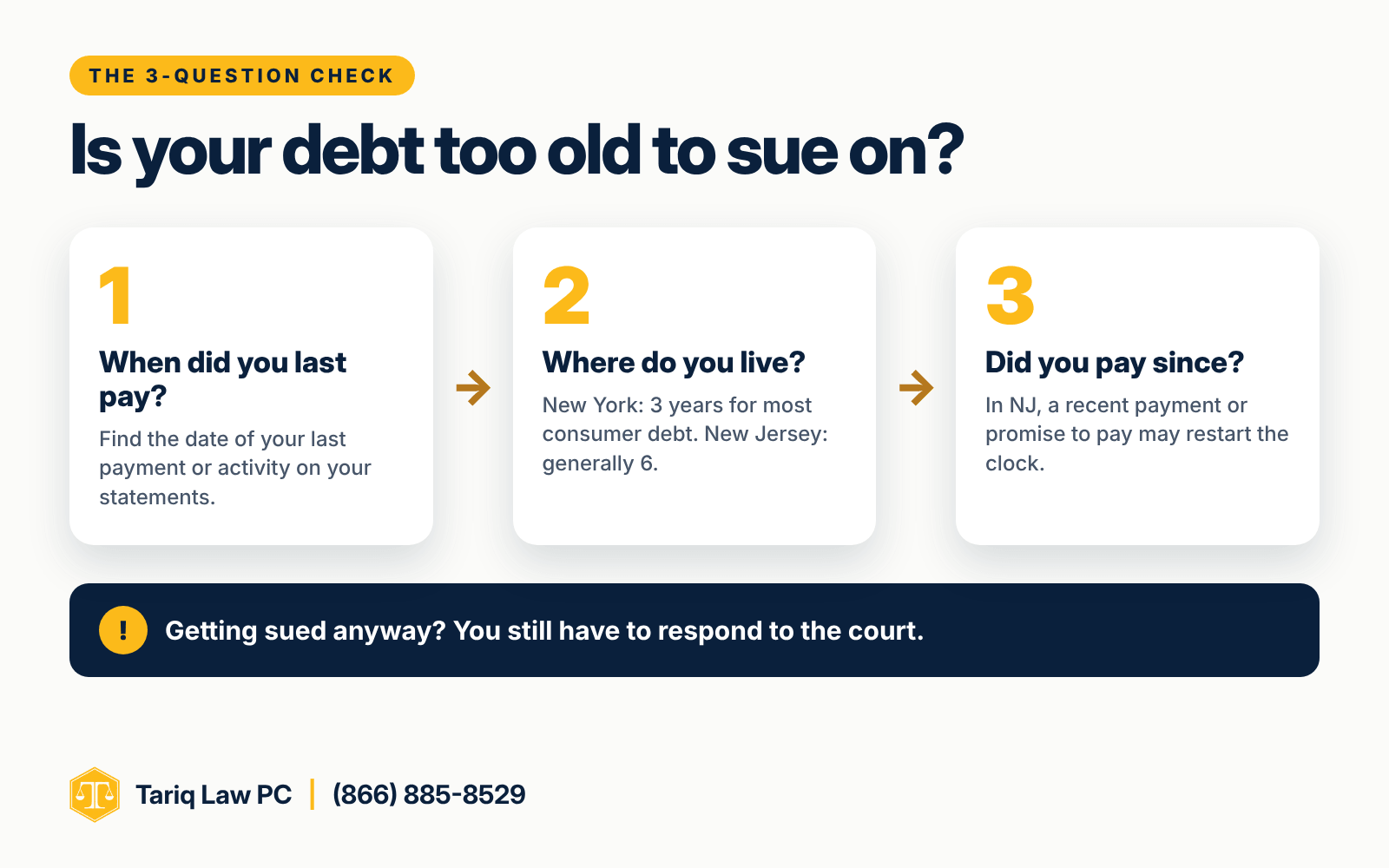
Find your last payment date. Old bank statements, card statements or your credit report can help.
Check your state. New York: 3 years for most consumer credit debt. New Jersey: generally 6.
Think about anything since. In New Jersey, a payment or written promise to pay may have restarted the clock.
Read the letter closely. In NYC, collectors now have to send a written notice before collecting on a time-barred debt.
Don't pay, promise or confirm anything on the phone until you know where you stand.
One big exception: you still have to show up to court
Here's the part that catches people. A debt being too old is a defense, not an automatic win. If a collector sues you anyway and you ignore the papers, the court can enter a default judgment against you, even on an expired debt. Then they can go after your bank account or paycheck.
Got court papers? Answer them, and raise the statute of limitations.
When Should You Talk to a Debt Defense Lawyer?
Consider reaching out if:
You've been sued over a debt you think is more than 3 years old (NY) or 6 years old (NJ)
A collector is threatening to sue on an old debt
You don't recognize the company that says it owns your debt
An old debt suddenly showed up on your credit report again
You already made a payment and aren't sure if it restarted the clock
You missed a court date and a judgment was entered
Tariq Law PC is a consumer protection law firm in New York City. We defend debt collection lawsuits, and we offer free case evaluations for qualified matters.
Frequently Asked Questions
1. Can a debt collector sue me after 3 years in New York?
For most consumer credit debt, like credit cards and personal loans, no. Since April 2022, New York gives collectors 3 years to sue, and threatening to sue on older debt isn't allowed.
2. How old does a debt have to be to be uncollectible in New Jersey?
New Jersey generally gives collectors 6 years to sue on contract debts like credit cards. After that, they can still ask you to pay, but they generally can't win a lawsuit if you raise the defense.
3. Will paying $20 on an old debt restart the clock?
In New York, a payment after the 3-year deadline can't revive the debt for a lawsuit. In New Jersey, a payment or promise to pay may restart it under current law. Talk to a lawyer before paying anything on an old debt.
4. Does the clock start when I opened the account?
Usually not. It typically runs from your last payment or the last activity on the account.
5. I moved from New Jersey to New York. Which deadline applies?
It depends on the facts, like where you lived when you defaulted and where you're sued. This is a question for a lawyer, not a guess.
Attorney Advertising. This article is for general informational purposes only and is not legal advice. Reading it does not create an attorney-client relationship. Deadlines depend on the type of debt and the facts. Past results do not guarantee a similar outcome. Attorney review pending.


