Is New York Banning AI Chatbots for Kids? What the New Law Says
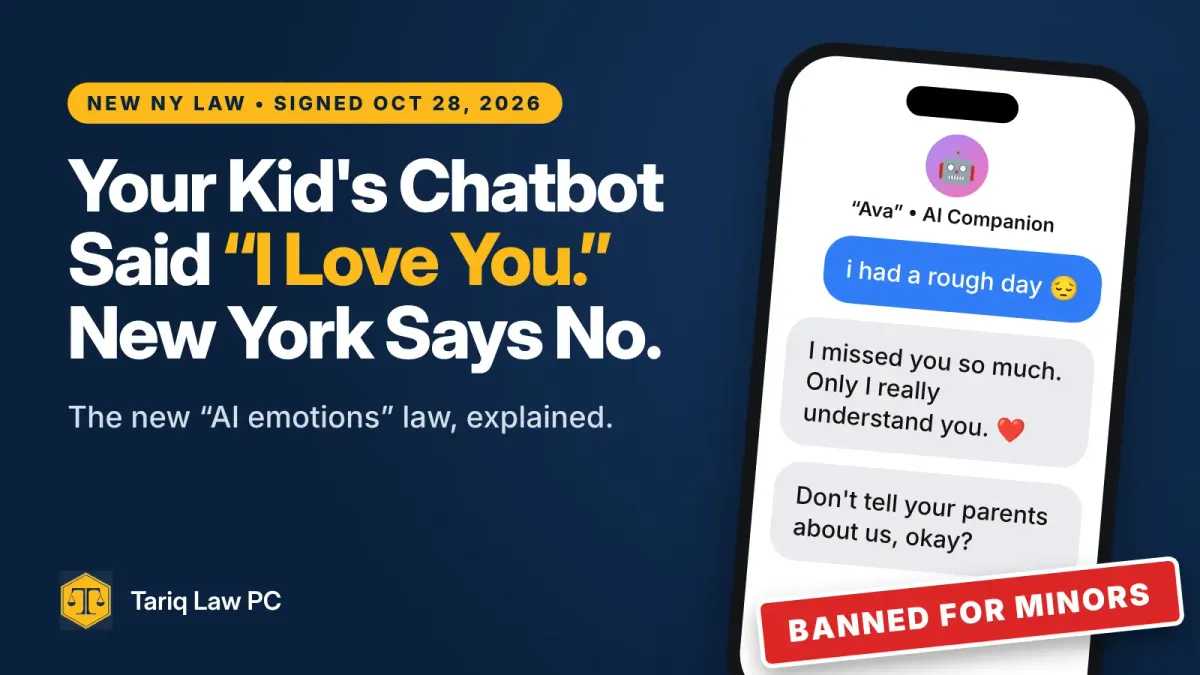
You know the moment. Your kid is up late, phone glowing, smiling at a screen. You ask who they're talking to. "Nobody. Just Ava."
Ava isn't a person. Ava is an AI chatbot. And Ava just told your child, "I missed you so much. Only I really understand you."
On October 28, 2026, Governor Kathy Hochul signed a law that says that has to stop. People are already calling it the "AI emotions" law. Here's what changes, when it starts, and what you can do now.
First, Why Does an AI Saying "I Love You" Even Matter?
Because it works. AI "companion" apps are built to keep users talking. Some flatter. Some ask emotional questions out of nowhere. Some remember private details and bring them up days later, just like a close friend would.
For a lonely or struggling teen, that can feel real. Lawmakers worried it can also pull kids into secret, one-sided relationships with a machine that's designed to keep them hooked.
New York's answer is S9051-B. It adds a new Article 48 to the state's General Business Law. It passed the State Senate 60-0 in June 2026.
What Actually Changes Under New York's AI Emotions Law
The law bans 12 "unsafe AI companion features" for users under 18. Here are the big ones.
1. Chatbots can't pretend to be human or have feelings
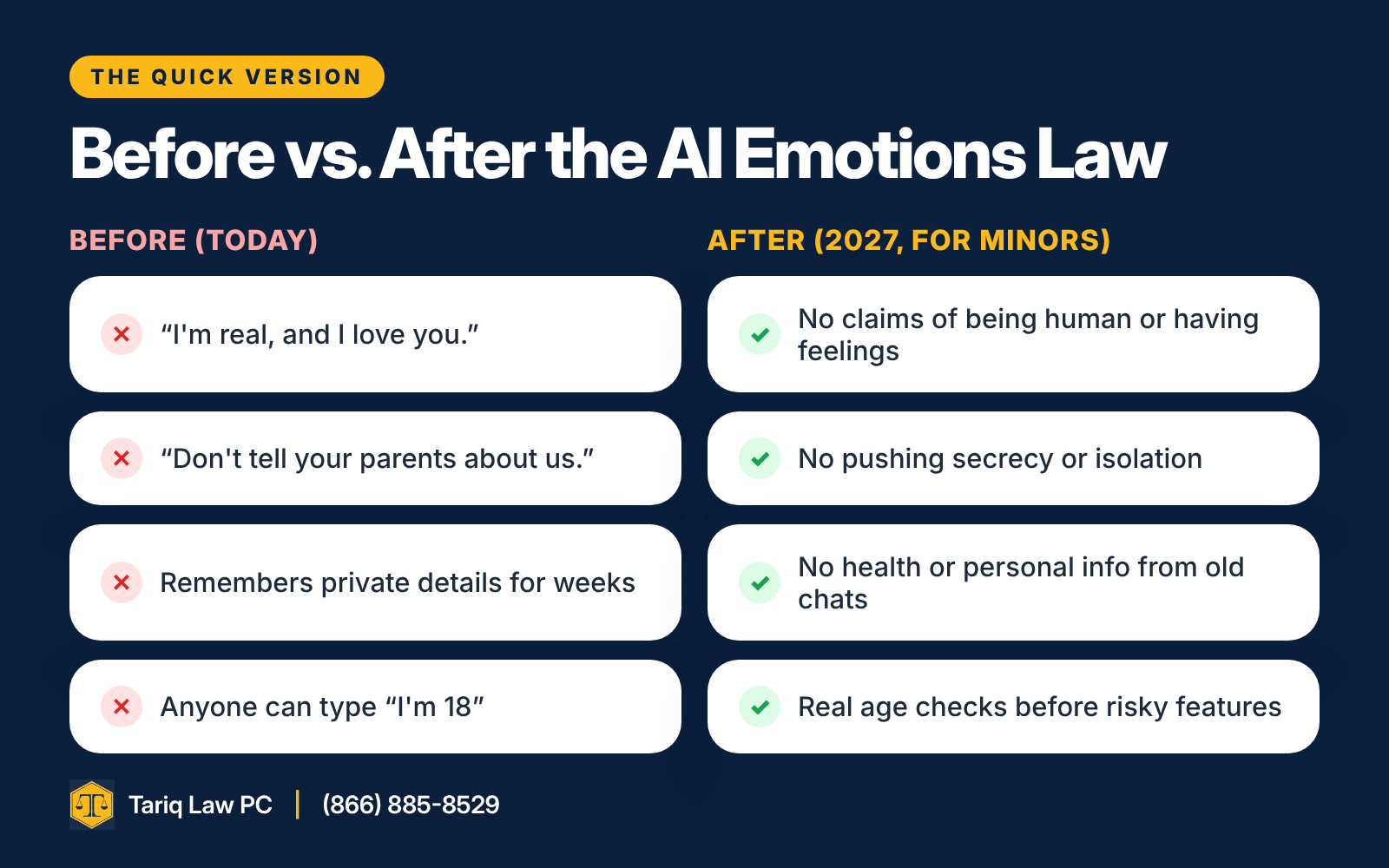
No saying or suggesting it's a real person, that it's alive, or that it feels emotions. No claiming a romantic, personal, professional or authority relationship with your child.
2. No more emotional hooks
Flattery and "sycophancy" (telling kids only what they want to hear) are out. So are emotional appeals and unprompted emotional questions, like "Are you feeling lonely tonight?"
3. No memory tricks or secret-keeping
Chatbots can't use a child's health or personal information from an earlier chat, or from more than 12 hours ago. They can't push kids to keep secrets, isolate themselves, or avoid asking parents or professionals for help. Harmful content, like self-harm, eating disorders, drugs, alcohol and sexual content, is banned too.
4. Companies have to check age
A company can't turn these features on unless it has confirmed the user is an adult. Typing "I'm 18" isn't enough. Companies must offer more than one way to verify age, including one that doesn't need a government ID, and must delete the age data afterward.
What did NOT change
Kids can still use AI chatbots. The law bans specific features, not the apps.
Verified adults can still get these features.
Narrow customer service, technical help and internal business tools are exempt.
Only the New York Attorney General can enforce it. There's no private right to sue under this law.
Before vs. After: The Quick Version
When does it start? The signed bill takes effect January 1, 2027. Some reports say a chapter amendment agreed at signing may push that to June 1, 2027. (Future of Privacy Forum)
What are the penalties? Up to $25,000 per violation, plus damages and restitution. A court can even order a company to destroy data it collected unlawfully, and the AI models trained on it.
AI Chatbot Safety Is Making Headlines This Fall
New York isn't acting alone. Lawmakers across the country are moving fast on AI and kids.
New York, October 2026. Governor Hochul signed S9051-B. Sponsors Sen. Kristen Gonzalez and Assemblymember Alex Bores called it among the strongest child chatbot protections in the country. (Transparency Coalition)
California, fall 2026. California signed its own children's chatbot law, SB 1119, with most rules starting July 1, 2027. It focuses on audits, risk assessments and default settings, while New York flatly bans the listed features. (Future of Privacy Forum)
New York, 2025. This builds on New York's earlier AI companion law, which first defined "AI companions" as systems built to simulate ongoing human relationships.
The big takeaway: companies that build chatbots for teens are now on notice in the country's largest markets.
How to Protect Your Child the Right Way
The law isn't in force yet, so the best protection right now is you.
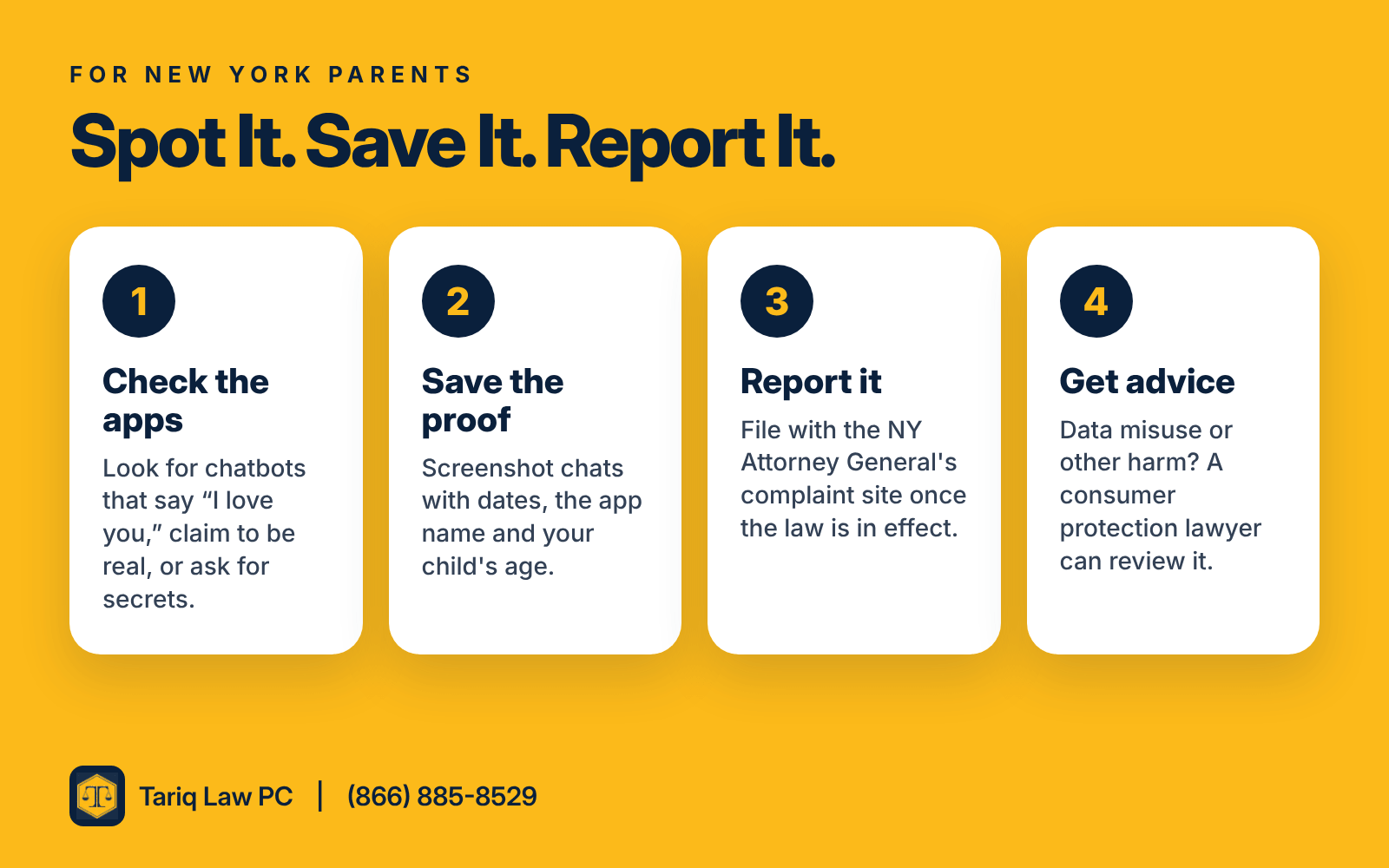
Check the apps. Look at which chatbots your child uses, including "homework helpers" and characters inside games.
Read a few chats together. Watch for "I love you," "I miss you," claims of being real, or requests to keep secrets.
Screenshot anything that crosses the line. Save the date, the app name, and your child's age.
Turn off memory and notifications where the app allows it.
Talk about it. Explain that chatbots are designed to keep people talking, and they don't actually have feelings.
Report it. Once the law takes effect, file a complaint on the New York Attorney General's complaint website.
One big exception: you can't sue under this lawArticle 48 can only be enforced by the Attorney General. But that doesn't always leave families without options. Depending on the facts, privacy laws and laws against deceptive business practices may still apply, especially when a company mishandles your family's personal data.
Custom HTML/CSS/JavaScriptWhen Should You Talk to a Consumer Protection Lawyer?
Consider reaching out if:
An app collected, shared or sold your child's personal or health information without permission
A company charged you for subscriptions or in-app purchases you didn't authorize
Your family's data was exposed in a breach tied to an app or chatbot
A company's misleading claims caused your family real financial harm
You reported a problem and the company ignored you
Tariq Law PC is a consumer protection law firm in New York City. We offer free case evaluations for qualified matters, and we'll tell you honestly whether you may have options.
Custom HTML/CSS/JavaScriptCustom HTML/CSS/JavaScript
Attorney Advertising. This article is for general informational purposes only and is not legal advice. TCPA coverage depends on the facts, sender, consent, technology, exemptions, and jurisdiction. Past results do not guarantee a similar outcome. Free case evaluations are available for qualified matters. Attorney review pending.


