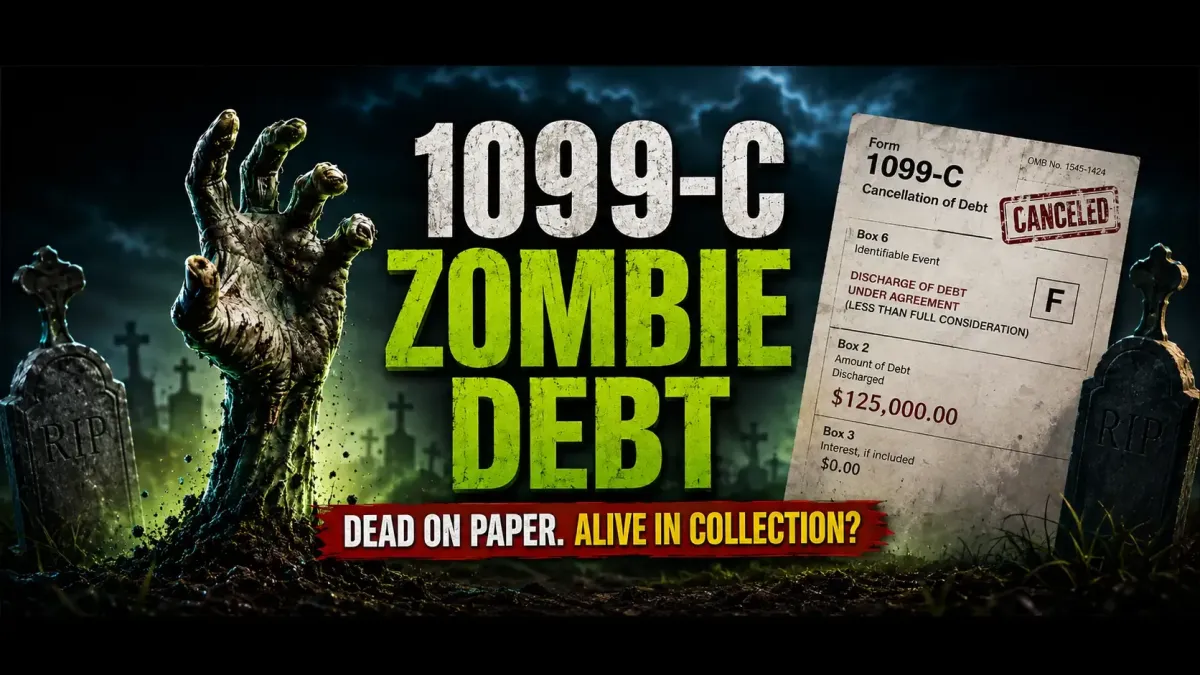
Form 1099-C Code F: Can a Canceled Debt Still Be Collected?
A financial institution reports a debt to the Internal Revenue Service as canceled. It sends the borrower a Form 1099-C titled "Cancellation of Debt." The borrower must then address that reported cancellation on a federal tax return. Later, sometimes later, the institution - or a debt buyer, servicer, collection law firm, or judgment creditor - attempts to collect the same debt.
For borrowers, this can feel like a debt that was declared dead but suddenly returned to life. The phrase "zombie debt" is not a formal legal term, but it accurately describes the practical problem: a creditor reports a cancellation to the federal government and the taxpayer, yet later takes a seemingly inconsistent position that the same obligation remains fully collectible. The law is more nuanced than either side often admits. A Form 1099-C does not automatically erase every debt. At the same time, the form is not necessarily meaningless bookkeeping. Its legal significance depends on the event code selected by the creditor, the year of the form, the circumstances that produced it, whether a valid correction was issued, how the borrower responded for tax purposes, and what the creditor's own records and conduct reveal.
The central question: What event did the creditor report, what evidence supports that event, and is the creditor's current collection position consistent with its prior reporting and conduct?
Charge-Off, Form 1099-C, and Legal Cancellation Are Not the Same Thing
Three concepts are frequently confused. A charge-off is generally an accounting treatment. A creditor may classify a loan as a loss without necessarily surrendering its legal right to collect. A Form 1099-C is a federal information return. It reports a cancellation-of-debt event to the IRS and the debtor. A legal cancellation, release, settlement, satisfaction, waiver, or discharge concerns whether the obligation remains enforceable under the governing contract, state law, judgment-enforcement rules, and equitable principles.
These concepts may overlap, but they are not interchangeable. A creditor cannot prove continued enforceability merely by calling the transaction a "charge-off." Likewise, a debtor ordinarily cannot prove complete legal discharge merely by producing a Form 1099-C without examining why it was issued.
What a Form 1099-C Does - and Does Not – Establish
Applicable financial entities generally must file Form 1099-C when a debt of at least $600 is canceled and a qualifying identifiable event occurs. The form identifies the creditor, the debtor, the date of the event, the amount reported as discharged, and the creditor-selected event code. The creditor must also furnish the relevant information to the debtor.
Federal regulations recognize that an information-reporting obligation can arise even when the form itself is not the legal instrument that cancels the debt. For that reason, courts have generally rejected the broad argument that every Form 1099-C automatically prevents future collection. That principle, however, has limits. The fact that the form is not automatically conclusive does not make it irrelevant. A properly authenticated form may still be evidence of the creditor's identification of the debt and debtor, the specific amount reported as discharged, the date of the reported event, the event code chosen by the creditor, and the consistency - or inconsistency - between the creditor's federal reporting and later collection activity. The legal force of that evidence must be evaluated together with the surrounding record.
Why Code F Can Be Particularly Important
Box 6 of Form 1099-C requires the creditor to identify the nature of the reported cancellation event. Under the IRS instructions, Code F means a discharge under an agreement between the creditor and debtor to cancel the debt for less than full consideration. A short sale is one example provided by the IRS.
Code F is therefore different from a generic charge-off notation. It is also different from Code D, which concerns a foreclosure election that, under applicable law, extinguishes or bars further collection.
When Code F is disputed: Why did the creditor identify an agreement-based discharge to the IRS and the debtor if no such agreement or cancellation existed?
Code F does not necessarily prove every element of an enforceable settlement. It does not, by itself, establish the precise terms of the agreement, the authority of the participants, the scope of the release, or whether claims against guarantors were preserved. State contract law still governs those questions. Nevertheless, Code F is the creditor's own reported explanation of the cancellation event. A court may reasonably consider it together with settlement communications, account records, collateral credits, internal calculations, tax treatment, correction history, and subsequent collection conduct.
The Historical Regulations Matter
Older decisions involving Form 1099-C must be read in their proper regulatory context. Federal regulations formerly contained a 36-month nonpayment testing rule. Under that former rule, certain creditors could be required to file Form 1099-C after a specified period of nonpayment even though the creditor had not actually forgiven the debt and might continue collection. The Treasury Department and IRS removed that rule because it created taxpayer confusion and could cause borrowers to report cancellation income even while creditors continued collection. The change became applicable to information returns and recipient statements required after December 31, 2016.
This history does not make every later Form 1099-C conclusive. It does mean that courts, attorneys, and borrowers should identify the year of the form and the particular event code instead of applying older cases mechanically. A later Code F form presents a materially different reporting explanation from a form issued under the former nonpayment rule.
What the Leading Decisions Actually Establish
There is not much developed nationwide rule governing the evidentiary effect of Form 1099-C. Courts have taken different approaches, and their decisions often turn on the specific event code, the available evidence, the creditor's intent, the correction history, and whether the debtor took a tax position in response to the form.
Bank of America, N.A. v. Rolf
For New York practitioners, Bank of America, N.A. v. Rolf, 188 A.D.3d 770 (2d Dep't 2020), is a key published appellate decision. The lender in Rolf issued a Form 1099-C bearing Code D, which related to a foreclosure election. The Appellate Division held that filing the form did not waive the lender's right to seek a deficiency judgment. The record demonstrated that the lender had not forgiven the loan and had no intention of doing so. The debtor also did not allege that he had reported the stated cancellation as part of his gross income. Rolf therefore establishes an important starting point: a Form 1099-C, by itself, does not necessarily prove waiver or discharge.
But Rolf does not establish that all Forms 1099-C are legally irrelevant. Its analysis depended on Code D, evidence of continued collection intent, and the absence of alleged tax reliance. A case involving Code F and substantial independent evidence of agreement-based cancellation presents a different factual record.
FDIC v. Cashion
In FDIC v. Cashion, 720 F.3d 169 (4th Cir. 2013), the borrower relied on the Form 1099-C as essentially the sole evidence that the debt had been canceled. The Fourth Circuit held that the bare form, standing alone, was insufficient to defeat summary judgment. The court carefully limited its decision. It described the case as an unusual situation in which the form was the only evidence of discharge. It expressly recognized that, in a different case, a properly authenticated Form 1099-C could be considered with other circumstantial evidence under the totality of the circumstances. Cashion therefore rejects an automatic-discharge theory. It does not require a court to ignore Code F or disregard independent evidence surrounding the creditor's reporting.
Wells Fargo Advisors, LLC v. Mercer
In Wells Fargo Advisors, LLC v. Mercer, 735 F. App'x 23 (2d Cir. 2018), the creditor represented that the original Form 1099-C had been issued inadvertently and corrected to show that no debt had been discharged. The borrower did not dispute receiving the corrected form or the creditor's description of its contents. The court also noted that the borrower did not allege that he had reported the canceled amount as income. It distinguished decisions involving debtors who had taken tax positions in response to the forms and creditors who had not issued corrections. Mercer is a nonprecedential Second Circuit summary order. It is nevertheless useful because it illustrates why a genuine correction and the debtor's tax response can matter. It does not establish that an unsupported statement of "clerical error" is enough when no correction or contemporaneous explanation exists.
Amtrust Bank v. Fossett
In Amtrust Bank v. Fossett, 223 Ariz. 438, 224 P.3d 935 (Ariz. Ct. App. 2009), the Arizona Court of Appeals held that issuance of a Form 1099-C could constitute prima facie evidence of cancellation under the applicable law. The court did not hold that the form conclusively ended the case. It allowed the lender an opportunity to rebut the evidence by showing that it did not intend to forgive the obligation. Because factual questions remained, the matter was remanded. Amtrust demonstrates a balanced approach: the form may carry evidentiary weight, but the creditor may rebut it with competent evidence.
Franklin Credit Management Corp. v. Nicholas
In Franklin Credit Management Corp. v. Nicholas, 73 Conn. App. 830, 812 A.2d 51 (2002), the creditor asserted that the form had been issued by mistake but offered no meaningful evidence explaining whether a mistake occurred or how it occurred. The debtor had addressed the reported cancellation for tax purposes, and no amended form had been issued. The Connecticut Appellate Court affirmed the determination that the debt had been discharged under the applicable law and that foreclosure would be inequitable. Franklin Credit does not create a universal rule. It demonstrates why an unsupported after-the-fact mistake explanation may be insufficient when the creditor's own form and the debtor's tax treatment point in the opposite direction.
What Separates a Strong Case From a "Bare Form" Case?
The most persuasive cases do not depend on the Form 1099-C alone. They examine the complete account history. The first question is the event code. Code F may support an agreement-based cancellation theory, while another code may reflect bankruptcy, foreclosure law, expiration of a statutory period, a creditor policy, or a different event.
The second question is whether the reported amount matches the obligation now being collected. In lending transactions, Form 1099-C generally reports stated principal. Interest and other amounts may be treated separately, and any interest included in Box 2 should also be identified in Box 3. Therefore, the form must be reconciled against the creditor's complete ledger, including principal, accrued interest, attorneys' fees, costs, collateral proceeds, settlement payments, and post-judgment interest.
The third question is what the creditor's contemporaneous records show. Relevant documents may include settlement communications, deficiency calculations, account notes, collateral-sale records, internal emails, tax-reporting worksheets, collection instructions, and communications concerning whether the remaining balance was expected to be collected. The fourth question is whether the creditor produced a real correction history. A statement made during litigation that the form was "a mistake" is not the same as a business record documenting the error. A meaningful correction history should ordinarily identify what was wrong, when the error was discovered, who authorized the correction, what information was changed, what was filed with the IRS, and what corrected statement was furnished to the debtor. IRS instructions provide procedures for correcting information returns when a filer discovers an error, including incorrect amounts, codes, or checkboxes. Corrected information must also be furnished to the recipient.
There is an important limitation. The IRS instructions state that a creditor is not required to file an additional or corrected Form 1099-C merely because it later receives payment on a debt previously reported. The absence of a correction is most significant when the creditor claims that the original form, amount, debtor, or event code was erroneous, not merely that money was later recovered.
A form marked "CORRECTED" also requires careful examination. The word alone does not show what was changed. The original form, the corrected version, and any later correction should be compared.
The Debtor's Tax Response May Matter
Cancellation-of-debt income is generally included in gross income unless an exception or exclusion applies. Depending on the circumstances, a taxpayer may use Form 982 to claim an exclusion based on insolvency, bankruptcy, or another provision of Internal Revenue Code Section 108.
A borrower who files Form 982 may not ultimately pay tax on the canceled amount. That does not mean the Form 1099-C had no consequence. The borrower still had to address the creditor's reporting within the federal tax system and take a formal tax position. For purposes of equitable estoppel, however, the tax filing alone should not be overstated. Under New York law, equitable estoppel generally requires conduct that misled the party asserting estoppel, justifiable reliance, and a detrimental change of position. Waiver also is not lightly presumed; it requires a knowing and intentional relinquishment of a known right, which may sometimes be demonstrated through conduct or failure to act.
New York authority: Fundamental Portfolio Advisors, Inc. v. Tocqueville Asset Management, L.P.
A legally persuasive claim should therefore identify the actual reliance or prejudice, which may include tax-preparation expenses, tax reporting, reduction of tax attributes, loss of financial options, changes in business or personal planning, or another concrete disadvantage.
"It Was a Clerical Error" Must Be Supported by Evidence
Financial institutions process large volumes of information returns, and genuine mistakes can occur. But a creditor asserting mistake should ordinarily be able to produce competent evidence. Depending on the circumstances, that may include an account-level calculation, an error report, a compliance review, testimony from a knowledgeable witness, an IRS correction, or a corrected statement sent to the debtor. The more specific the original filing is - the identified debtor, exact dollar amount, date, account information, and Code F - the more important a documented explanation becomes. A creditor should not automatically prevail merely by relabeling its own federal reporting as a clerical error after collection becomes contested. Conversely, a debtor should not automatically prevail merely because the creditor's explanation appears incomplete. The issue is whether admissible evidence establishes actual cancellation, waiver, estoppel, settlement, satisfaction, or another defense to enforcement.
What Happens When a Judgment Already Exists?
A Form 1099-C does not automatically vacate an existing judgment, remove it from the judgment docket, release a lien, or direct a clerk to mark the judgment satisfied. The validity of the original judgment and its present enforceability may be separate questions. A creditor's conduct after judgment - such as a settlement, release, collateral disposition, cancellation reporting, waiver, or representation that a deficiency will not be collected - may affect whether some or all of the remaining balance is enforceable. Depending on the procedural posture, a debtor may need declaratory relief, injunctive relief, satisfaction-related relief, or another appropriate court order. The existence of a Form 1099-C should not be treated as a substitute for obtaining the relief needed to stop active judgment enforcement.
What About Guarantors and Co-Obligors?
A Form 1099-C issued to the primary borrower does not automatically release every guarantor or co-obligor. The analysis depends on the underlying agreement, the guaranty language, the scope of any settlement or release, whether rights against guarantors were expressly reserved, and whether the creditor is attempting to collect the exact deficiency it reported as canceled.
New York recognizes that a guaranty ordinarily involves secondary liability. In PAF-PAR LLC v. Silberberg, the First Department held that guaranty language could not make the guarantor liable for more than the modified obligation the primary borrower was required to pay and had paid. But the effect of any particular cancellation or release on a guarantor remains document-specific.
The proper question is not merely whose taxpayer identification number appeared on the form. It is whether the underlying obligation remained enforceable, whether claims against other obligors were preserved, and whether the creditor is attempting to revive the same balance it previously treated as canceled.
What Should a Borrower Do When Collection Continues?
Do not assume that the debt automatically disappeared. Do not assume that the form is worthless either.
Preserve and organize:
Every original and corrected Form 1099-C or Form 1099-A;
The envelope or electronic delivery record;
Tax returns, Form 982, insolvency calculations, and IRS transcripts;
Settlement correspondence and payment records;
Collection letters, account statements, and payoff calculations;
Collateral-sale, foreclosure, or repossession documents;
Bankruptcy schedules and proofs of claim, where applicable; and
Court papers, judgments, liens, restraining notices, and enforcement documents.
Identify the form year, Box 2 amount, Box 3 interest, Box 6 event code, and any account number. Compare those entries with the creditor's current demand. Request the creditor's complete calculation and correction history in writing. Ask what identifiable event supported the form, why the particular code was chosen, whether the creditor filed a correction with the IRS, and whether a corrected statement was furnished to the debtor. Never ignore a summons, foreclosure notice, income execution, restraining notice, subpoena, bankruptcy deadline, or judgment-enforcement document while investigating the Form 1099-C issue.
Tariq Law's Approach to 1099-C Zombie Debt
A meaningful Form 1099-C investigation does not begin and end with the tax form.
Tariq Law examines the complete creditor-created record:
What did the institution report? Why did it select that event code? What agreement or identifiable event supported the filing? What did its internal records say? Did it properly account for collateral or settlement payments? Did the debtor take a tax position? Was the form genuinely corrected? Is the institution now collecting the same principal from the borrower, a guarantor, or both?
These cases can involve contract law, judgment enforcement, secured transactions, tax reporting, waiver, equitable estoppel, guaranty law, and evidentiary issues. The outcome depends on the jurisdiction and the specific documents - not on slogans from either creditors or debtors. A Form 1099-C may not automatically kill a debt. But a creditor also should not be permitted to treat its federal cancellation reporting as meaningful when it imposes tax obligations on the debtor and meaningless when the creditor later seeks collection.
Individuals and businesses that received a Form 1099-C - particularly a form bearing Code F - and are now facing collection of the same reported obligation may contact Tariq Law PC.


